What You Need
Players Anywhere from one to eight people can play. One person will be the Dragonhead Master or DM and control the creatures in the game. The rest will be Player Characters or PCs and play the game's heroes. If you don't have a DM then everyone should roll a 1d20. Whoever rolls the biggest number is your new DM.
All hail the new DM!
Polyhedral Dice
 For dice you need at least one set of polyhedrals containing a d4, d6, d8, d10, d12, d20 and d00. It plays best with three six-sided and three twenty-sided dice as well.
Percentile Dice The d00 is known as the percentile die. Both it and the d10 have ten sides but the d00 has two numbers per side. Roll them together to create a number from 1 to 100. The d00 provides the tens digit. The d10 provides the ones digit.
| d00 | d10 | Die Roll |
| 50 | 2 | 52 |
| 00 | 1 | 1 |
| 00 | 0 | 100 |
That last one tends to throw people off, but rolling nothing but zeros is a 100. When rolled separately, rolling a 00 on the d00 is 100 and rolling a 0 on the d10 is a 10.
Downloads The Character Sheet pdf contains the game's character sheet and placemat. The Cheat Sheets pdf is a quick reference guide to the game's most important parts. It is also available in Booklet form for anyone daring enough to print it out and staple it together. Optional but also quite useful is the Challenge Wheel pdf which helps turn strength into success.
A Place to Play Preferably a large table with nice seats in a room without much noise. If you can't hear what is being said you can't play the game. If snacks are to be had, be sure to bring something to share or at least be ready to throw in for pizza.
Game Time Time mentioned in the rules has nothing to do with time spent at the game table. Depending on what is happening, a few seconds for the characters might take a few minutes for the players, meanwhile a few months could pass in a matter of seconds.
Game Time is supremely flexible.
The only time that matters for players is the Game Session. This is what we have to play with and can range from ten minutes to three hours. Once you hit that three hour mark you should either start a new game session or call it a night.
Yes there is a reason for that.
Concepts
These often trip people up when they don't know about them. So here they are. Watch your feet and consider yourself warned.
Exceptions Many of the rules in this book are fairly cut and dry but all come with an unwritten caveat — unless something says otherwise — meaning there will always be exceptions.
For example, you cannot sleep in your armor (unless something says otherwise). In the class description of the Dwarf it says that they can sleep in their armor so this rule does not apply to them.
Characters & Creatures PCs run Characters while the DM runs Creatures. Both are figments of your imagination defined by a bunch of stats on a page. They play by the same rules making the two terms interchangeable. Unless something says otherwise (there it is again!) what applies to characters also applies to creatures and vice-versa.
Always Round Down The math in this game is nothing complex but every now and then it will leave you with a decimal point. When that happens simply lop it off, aka Round Down. A 7.1 as well as a 7.5 and 7.9 all round down to 7.
Threshold Tables Many of the tables used in the game are Threshold Tables. Each entry starts with a single threshold number like so:
The number tells you where the entry begins. Roll a 1d12 with the table above and a 3 would have you encountering some Hobgoblins. A 4 would have crossed that threshold and met up with some Orcs. Anything with a 9 or higher is an encounter with some Elves.
A cool thing about threshold tables is that because we always count from low to high they can be arranged in ascending or descending order or even laid out on their side like so:
The Middle PCs always roll the dice. DMs have the option of taking the middle. Take the best possible roll, cut it in half and round down. Instead of rolling 3d6, whose best possible roll is 18, you get a 9. Taking the middle is not as much fun as rolling the dice but it helps immensely when dealing with large numbers of creatures.
Dice Glyphs
Because big rolls like 1d100+1d20+1d6+1 are a bit of an eye sore the game uses dice glyphs to make them more legible. When you see a glyph like  the number tells us what die to roll, in this case a 1d6.
Dice glyphs turn 1d100+1d20+1d6+1 into 

 . If you don't want to use glyphs you can turn them off by clicking Settings in the tool bar.
Knowing The Rules For most games you need to know the rules, if not memorize them, before you can play. This is not one of them.
If you are short on time, borrow a character from someone at the table, explain to them that you have no idea what you are doing, and just play the game.
RPGs are collaborative not competitive.
This isn't poker. There is nothing to be gained from trying to outdo you and everything to be gained from helping you become a better player. The people around the table will probably be more than happy to fill you in on how the game is played.
Omniscient RPG Dragonhead is what is known as an Omniscient RPG. You are not always in character. Sometimes you pretend to be the character, talking on their behalf. At other times you merely control them, talking as if they were standing in the room with you.
It is not uncommon for players to run more than one character at a time, but as the number of people at the table increases the number of characters per person should decrease. With groups of six or more you should stick to just one character per person.
You may swap characters with other PCs or even give them to the DM to run as NPCs (non-player characters). At the end of the game all character sheets go back to the DM. They do not go home with you.
Real Playing Game You thought the R stood for Role? Not in Dragonhead. Here the R stands for Real. While there is a decent amount of role-playing involved and many fantastic things can happen, at base we play by reality's rules hence the term Real Playing Game.
Ultimately, this is what separates all RPGs from other games. In Monopoly you can only move around the board in a clockwise direction. Your actions are limited to buying hotels, paying rent, drawing cards, etc. If Monopoly were Dragonhead you could cut across the board, break your friends out of jail and party like rock stars, trashing the hotels on Boardwalk.
You may not get away with it, but you could try.
When it comes to what a character can or cannot do in a real playing game, we imagine it happening as if it were all really happening and go with what our imaginations show us, keeping things true to life.
The rules are not here to limit your actions.
The rules are here to make the fantasy seem real.
Mojos
In Dragonhead, you and your friends are unacknowledged gods. Your characters are your chosen heroes. As a god you have a celestial currency known as the Mojo which allows you to assert your divine presence and pull the strings of fate in their favor.
Each game officially begins with everyone (DM included) making a mojo roll to figure out how many mojos they get. What you roll depends on the number of people at the table. Anyone who shows up late can still play but they get no mojo.

| Players | Mojo Roll |
| 1 | 5d6 |
| 2 to 3 | 4d6 |
| 4 to 5 | 3d6 |
| 6 to 7 | 2d6 |
| 8 or more | 1d6 |
Anything from quarters to checkers can be used as a mojos, but the plastic gold coins sold as Pirates Treasure work best. You will also need a bowl to collect them in as mojos are spent. During an adventure here is what they can do and how much it costs.
Fudge The Dice 1 Mojo. Don't like what you rolled? Spend a mojo and re-roll the dice. This can be done up to three times per roll. You may not return to a better roll. It cannot be done during character creation or used with the mojo roll itself.
Rise Above 1 Mojo. The character becomes filled with an inexplicable surge of energy. Each mojo spent adds a +2 to the score being checked.
Divine Wind 2 Mojos. A mysterious wind blows away 1d20 points of wear damage. Additional characters may be healed by the wind at a cost of 1 mojo per character. Roll separately for each character.
Premonition 3 Mojos. Retroactively, you grant a character a premonition allowing them to have seen the mess they are currently in and done something about it beforehand.
Gift of the Gods 5 Mojos. You bestow upon the party something they desperately need. This should not be a major game changer, such as an important villain found inexplicably tied up in the town square.
Resurrection 7 Mojos. You bring a character back from the dead. The character will be as healthy as they had been during the last year of their life. They will have no idea what just happened or how or why they are alive again.
Dream Sequence 9 Mojos. Everything that happened since the last time the characters slept was a bad dream of ill portents which the party just woke up from. Do they dare try it again?
Act of God 12 Mojos. In the grand scheme of things, earthquakes, forest fires, eclipses and comet strikes happen all the time. This one just happened to happen right when the party needed it to.
Mojos can be spent on characters or creatures. You may even pool your resources to pull off something big like an Act of God. However, the only way to get mojos is to show up to the game on time, or play until the current session ends (three hours) and a new one begins. Mojos do not carry over between gaming sessions so use them before you lose them!
Character
Every player needs at least one character to give them a presence in the world. While there are rules for character creation, sometimes the quickest way to get going is to use one of the game's sample characters such as our favorite wanna-be warlord Megan Steelion.
Dragonhead character sheets are designed to be printed in landscape mode on the front and back of a single sheet of paper. Down the middle of the sheet is a thin silver line. Fold the sheet along this line and it divides the sheet into four smaller pages known as Character, Combat, Equipment and Experience.
Character
Character contains all of the character's abilities, class features, inclinations, name, etc. Aka the stuff you need outside of combat.
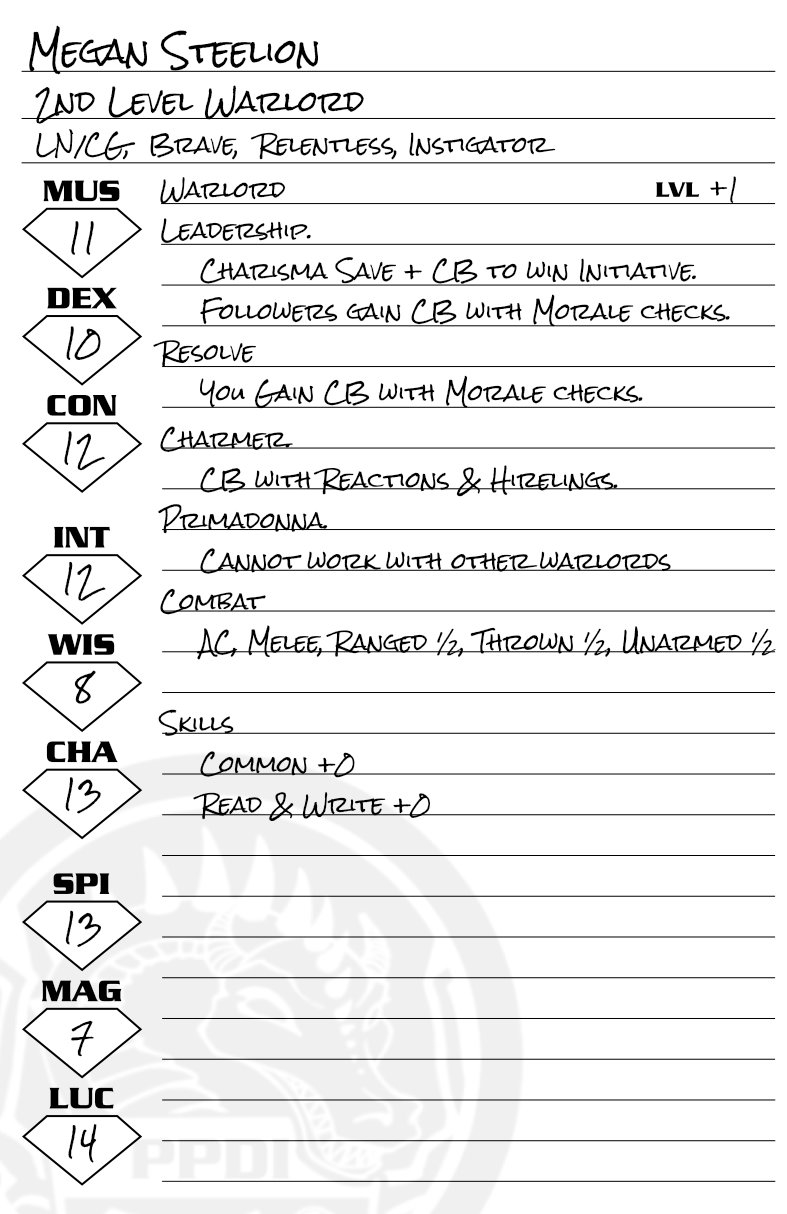
Existence This is our name for the top three lines. The character's name goes on the first line. Character Level and class go on the second line. Inclination and personality go on the third line.
Character Level encompasses the entire character and comes from the amount of XP spent on the character. We use it to pair characters with adventures. Megan is a 2nd level character and still a beginner with this whole adventuring thing.
| Adventure | Levels |
| Beginner | 1 to 3 |
| Intermediate | 4 to 6 |
| Expert | 7 to 9 |
| Hero | 10 to 12 |
| Master | 13 to 15 |
| Demigod | 16 and Up |
Personality A character's personality begins with Inclination and ends with some traits. Inclination tells us how a character is inclined to act. It is no guarantee.
| LG | = Lawful Good |
| NG | = Neutral Good |
| CG | = Chaotic Good |
| LN | = Lawful Neutral |
| TN | = True Neutral |
| CN | = Chaotic Neutral |
| LE | = Lawful Evil |
| NE | = Neutral Evil |
| CE | = Chaotic Evil |
Megan has two inclinations separated by a slash: LN / CG. The first is her Social Inclination. This is the face she shows the world. It's how a character wants to be known. It shows up in the way they dress, the way they talk, the friends they keep, etc. The second is the character's True Inclination. This is who they actually are. If the character has just one inclination then they are the same person inside and out.
Alignment occasionally comes into play, and that is the Good, Neutral or Evil part of a character's True Inclination. It refers to the divine forces of Good and Evil and which side the character is aligned with. Neutral characters are not aligned with either side and hence Unaligned.
Megan is Lawful Neutral on the outside and Chaotic Good on the inside, which makes her a Good aligned character. She tends to be Brave, Relentless and something of an Instigator. Personality traits are non-binding, meaning nothing bad will happen if you go against the grain of them. However we don't put stuff at the top of a character sheet just to be ignored.
Abilities Streaming down the left side of the sheet are your nine abilities. Three physical. Three mental. Three metaphysical. They are often known by the first three letters of each ability name.
| Mus = Muscle, the meat that makes a body move. | |
| Con = Constitution, ones health and natural good looks. | |
| Dex = Dexterity, your reflexes, speed and precision. | |
| Int = Intellect, the sharpness of ones mind. | |
| Wis = Wisdom, intuition and perception. | |
| Cha = Charisma, the force of personality. | |
| Spi = Spirit, the source of will. | |
| Mag = Magic, ones natural talent with the forces of magic. | |
| Luc = Luck, the grace of the universe shining upon you or perhaps not. | |
Each ability comes with a score that measures the character's potential. 10 is the universal average. On the whole:
| Score | Description |
| 18 and up | Astounding |
| 15 to 17 | Excellent |
| 12 to 14 | Great |
| 9 to 11 | Average |
| 6 to 8 | Pathetic |
| 3 to 5 | Weak |
| 2 or less | Sad |
Megan has excellent constitution, is very intelligent, charismatic and lucky, but she tends to be lacking in the wisdom department and it's probably best not to let her anywhere near a magic item.
Class There are three different kinds of classes: Races, Callings, and Transformations. A race is something you are born into such as Elf or Dwarf. A calling is a direction in life you feel called to pursue like Warlord or Wizard. A transformation comes from something happening to the character while out on adventure. A werewolf bite turns you into a Werewolf. All callings and transformations are human by default but they may be used by other races.
Classes come with a level to tell us how advanced the character is. The more advanced you are the more potent you become.
| Beginner | 1 to 3 |
| Intermediate | 4 to 6 |
| Expert | 7 to 9 |
| Hero | 10 to 12 |
| Master | 13 to 15 |
| Demigod | 16 and up |
While this is the same table used by Character Level, it is good not to confuse the two. Anything a class is good at gets a Class Bonus or CB equal to the class level. Megan is a 2nd level character but only a 1st level Warlord, so she gets a +1 when doing Warlord things.
Classes also come with a number of special features commonly scribbled beneath the class name on the character sheet. Be sure to take a moment and read about them before the game begins.
Skills Dragonhead is not a skill-based game. Skills exist to help you do things better. There are only a few notable exceptions (such as the Language skills) where you need the skill to do a thing.
Without a language skill you cannot speak. You get by with emotive grunts, barks and other noises but actual words are foreign to you. Likewise, everyone in Dragonhead is functionally illiterate. You cannot read or write without the Read & Write skill. Although, once you have it you may read or write any language you speak.
Megan has Common +0 and Read & Write +0. Common is the language of trade and called as such because it is so commonly spoken. Those +0's are not very helpful but they do tell us that the character possesses the skill.
Combat
The combat page contains everything you need for combat. The area at the top is for taking damage. The area below it is for dishing it out.
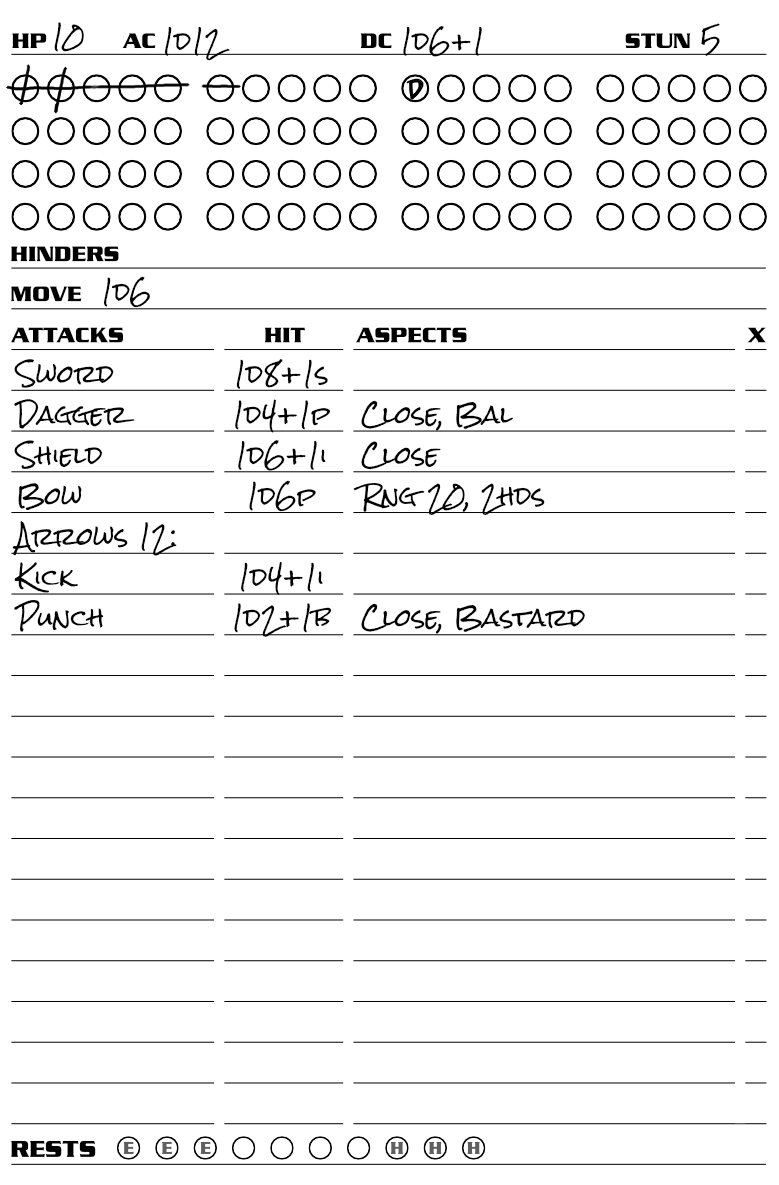
Hit Points Also known as HP, hit points tell us how much damage the character can take. Damage comes in two forms Wear and Tear. Wear is exhaustion and recorded with a horizontal line through the damage circles. Tear is actual physical damage and recorded with vertical strikes. Take too much wear and you pass out. Too much tear and you die. How much is too much? Cross the D and find out.
Damage Damage should always be described using one of the four damage types which help turn wear into tear. In nearly all cases:
| Type | Ratio |
| Sharp | 1 : 1 |
| Mixed | 2 : 1 |
| Blunt | 4 : 1 |
| Impact | 6 : 1 |
 Wear is always equal to the damage done. Tear damage depends on the wear damage. Blunt has a 4:1 ratio so that means it takes 4 points of wear to do 1 tear of damage. After recording wear damage go back to the first untorn circle and recount the wear damage but this time vertically strike a circle every time the ratio tells you to.
AC / DC These two protect you from being hit in combat. AC is used against nearly everything. DC is used in surprise situations, against back attacks, or any time you drop your guard. If there is just one number use it for both AC and DC. Otherwise the first number is AC and the second is DC. Because of her high Luck ability, Megan uses a 16 for both AC and DC.
Armor Armor protects you after being hit. It is a die roll that subtracts from the incoming damage. The die roll in parenthesis is Megan's shield. It is kept separate from her armor since the shield only protects her front and sides. When attacked from those directions you should roll your armor and shield and combine them.
Stun This is the amount of damage that it takes for a single blow to stun your character. Which basically means you lose your next action. Take double that amount and it knocks you off your feet.
Hinders This is space for jotting down any penalties your character may be suffering from. A hinder's penalty effects every check you make that is not a saving throw. Because they can easily come and go, hinders are never factored into the rest of your character sheet.
Megan's Packing -2 (with pack) means that she is carrying too much stuff and will suffer a -2 while carrying it. The (with pack) part means the excess weight is in a pack that can be dropped in an emergency to return to making normal checks.
Move Move tells us how she moves and at what speed. In combat Walk 4 means you can move her mini four spaces per round. In wilderness adventure it is a speed roughly equal to 4 mph.
Attacks This is a list of the weapons, spells, claws & jaws and other attacks you can make during combat.
Hit is the score you use to make the attack. It combines your abilities, class bonus, skill bonuses, etc to give you a single number that can be used without having to think too much about it. Because they change so often, Hit scores leave out hinders.
Dmg is short for Damage. This is what you roll to determine the damage done. The small letters at the end of each die roll tell us its damage type, ex: s = sharp.
Aspects are tags that tell us something about the attack. Close means the attack can only be used up close. 2hds requires two hands to use. A complete list of Aspects can be found in the Adventure section.
X is only used with magic spells. A number tells us the spell's level. Once X-ed out that spell is no longer available.
Size Size is the general size category your character fits into. When Medium you don't need to worry about size. Otherwise you should read up on Body Size in Adventure.
Rests A rest is when your character stops for a minute to catch their breath and recover some wear damage. A character can only rest ten times a day. The letters inside the circles tells us their difficulty. The first three rests are easy to make. The last three are hard. Mark them off as you take them. Erase the marks after a good night of sleep.
Equipment
The third page lists all the stuff your character is carrying. Wt is the weight of an item in pounds on your person. Pk is the weight of an item being carried in a pack of some sort. Notes is space for anything you would like to jot down about the item. A letter number combination such as s6, a5 or w6 tell us its shield, armor and warmth values respectively.
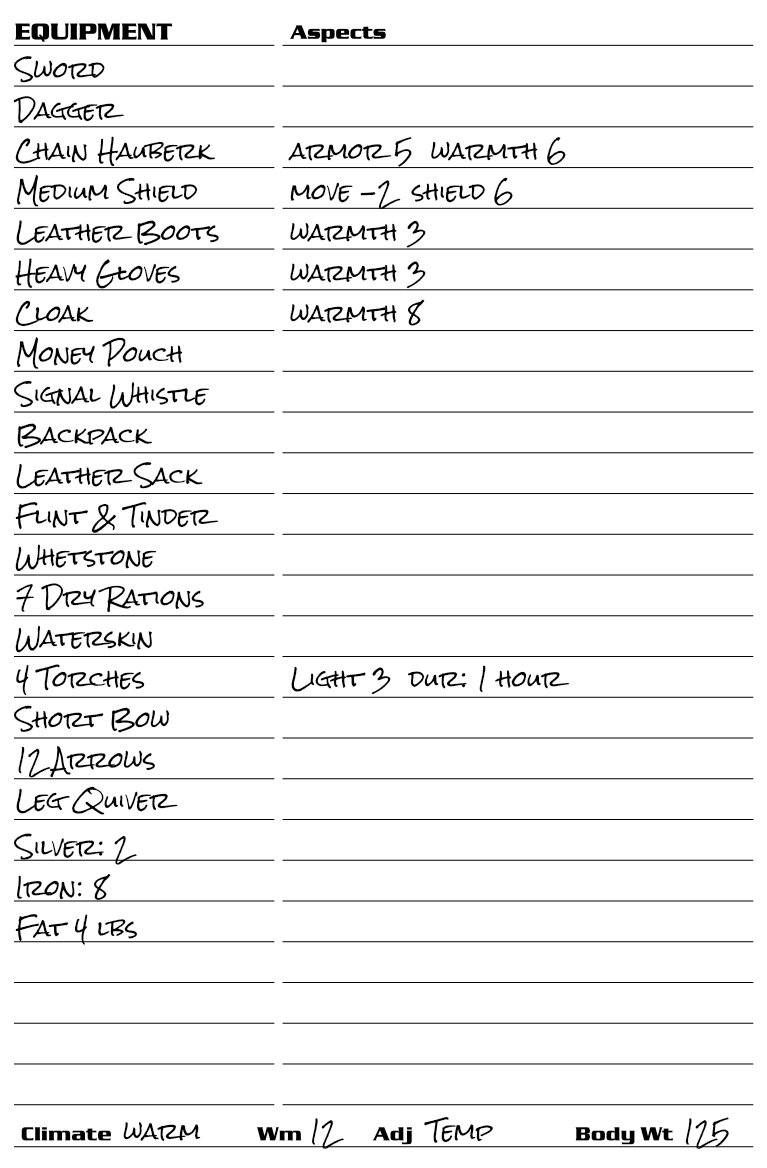
Encumbrance Dragonhead is a real playing game and in reality encumbrance matters. It comes with six different levels that have been shortened to better fit the character sheet.
| Level | Penalty | Movement |
| Moving | -0 | 100% |
| Packing | -2 | 100% |
| Lugging | -4 | 75% |
| Trudging | -6 | 50% |
| Straining | -8 | 25% |
| Stopped | -10 | 0% |
The weights on a character sheet tell us where each encumbrance level starts. Moving begins at zero and lasts until Packing, which for Megan begins at 48 pounds. At 96 pounds she starts Lugging, and so on. Stopped is the most she can carry and remain upright.
Penalty is the hinderance you take while encumbered at a certain level. Movement reduces your movement speed by a percentage, rounded down to a minimum of 1.
The Totals at the bottom of Equipment are the columns added up and rounded down the nearest pound. While this may seem a bit like overkill, the game doesn't expect you to constantly monitor your equipment weight. It's on the back of the sheet for a reason.
Encumbrance comes into play when you are creating your character and again when you pick up or drop something substantial. If the weight change doesn't seem like something that should matter then it doesn't.
Climate Climate is your character's natural habitat. Wm is short for Warmth and the total number of warmth points you are getting from your equipment. Adj is short for Adjusted Climate. It is your natural climate moved one step towards arctic by every 10 points of warmth. Climate is rarely ever used in dungeon adventuring, but it is an important part of wilderness adventure.
Body Wt is the weight of your character in pounds, sans fat. In Dragonhead, fat is fuel and will help keep you from starving to death, so we treat it like equipment. Body weight has nothing to do with climate but every two pounds of fat does provide one point of warmth.
Experience
The last page is primarily used to keep track of your experience points or XP. Unspent XP is what you have accumulated but not yet spent. Spent XP lists what you have spent XP on. Total Spent is all of your spent XP added together and determines your character level.
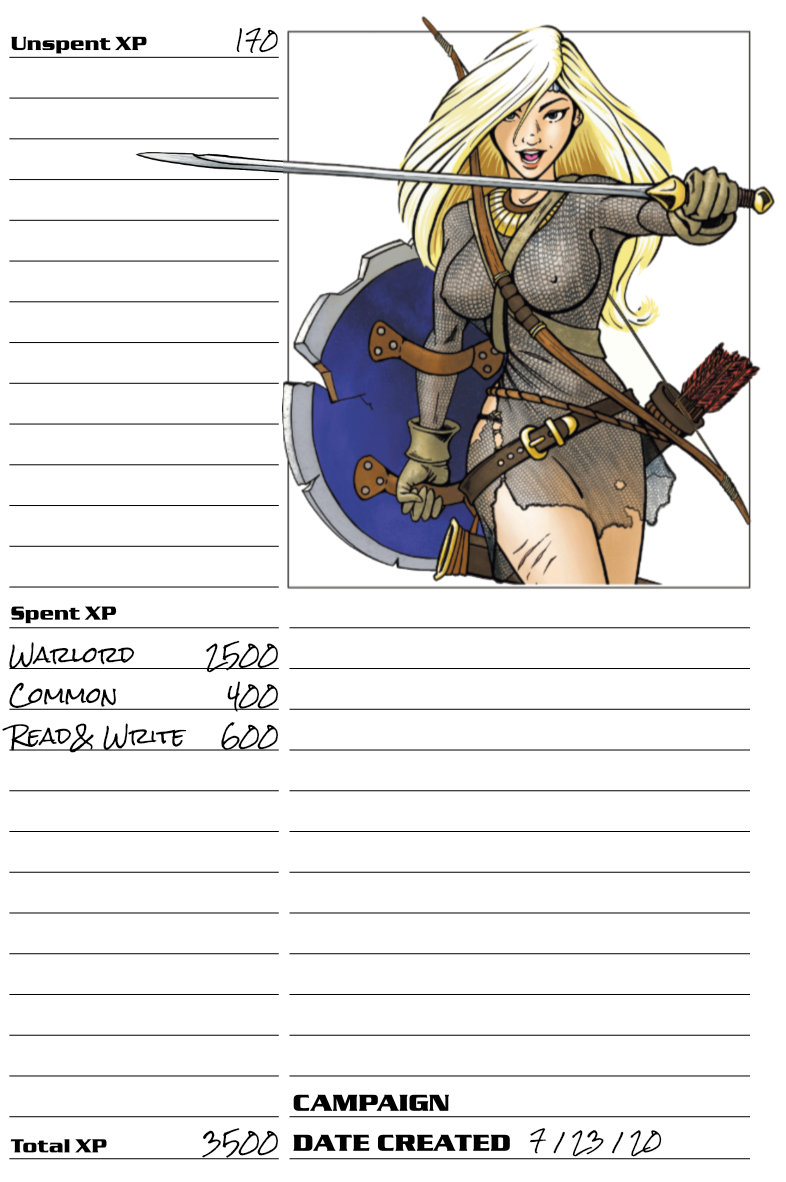
If you are artistically inclined, there is space for a picture of your character. The space below it is open for anything else you would like to jot down. Campaign is the name of the campaign the character is currently in. If the campaign doesn't have a name, use the name of your DM. Date Created is when you created the character.
Placemat
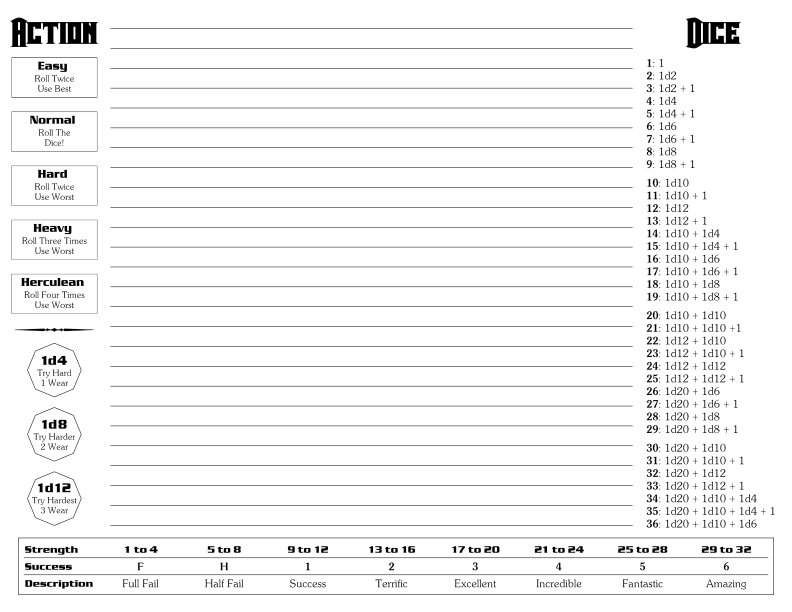
The character sheet pdf contains more than just a character sheet. The third page is known as the game's Placemat, called as such because you print it out and lay it flat on the table under your character sheet. The left sidebar reminds us of how actions work. On the bottom is the Success table. The right side bar gives us the most commonly used dice table entries from the cheat sheets. The lined area in the middle is for jotting down notes.
Creation
For your first character, follow these instructions, reading each passage as a guide. After that you should have no problem creating characters quickly using just the Character Creation Cheat Sheet.
For an even faster way to create a character check out the Character Creator on this website. Otherwise, print out a character sheet, wrangle up some dice, and let's roll!
1.) Abilities
Roll 3d6 for each ability score. Any roll of 7 or less may be re-rolled but only after first re-rolling the best score you have.
During character creation you may be asked for an ability modifier. Use the table below to turn scores into modifiers. Other than your Muscle Modifier (or MM) these do not need to be written on your character sheet.
| Score | Modifier |
| 18 | +4 |
| 16 to 17 | +3 |
| 14 to 15 | +2 |
| 12 to 13 | +1 |
| 10 to 11 | +0 |
| 8 to 9 | -1 |
| 6 to 7 | -2 |
| 4 to 5 | -3 |
| 3 | -4 |
For scores outside the range of 3 to 18 you can find its modifier by subtracting 10 from the score and dividing what remains by 2. A 22 minus 10 is 12 which divided by 2 creates a +6.
2.) Class
Go through the classes in the Keeper and choose one. Note the Best Abilities attached to each class, if they describe your character's best abilities then that is probably a good class for you.
Write down the class name and its level directly across from the Muscle diamond. New characters start at first level. Unless you are creating a character for an adventure with a recommended range of levels, in that case start at the lowest level of the range. If the adventure says it is for Character Levels 4 to 6 your new character starts at level 4.
Below the class jot down any features it grants. SA stands for Starts At and is the level you get the feature at. The fighter's Eye of the Tiger has SA 3 so you won't get it until third level is reached.
On the back of the character sheet, jot down the class name and the amount of XP it takes to reach that level under Spent XP.
Skills New characters get one language skill of their choosing at +0. Most go for Common +0 which costs 400 xp and is the most commonly spoken language around. Brand new characters with an Intellect +1 or better can get Read & Write +0 which costs 600 xp. All characters are functionally illiterate, only able to read simple things like signs and menus, without this skill.
On your character sheet, beneath the class and its features, write the word Skills and list below it your skills and their modifiers. On the back of the sheet write down the skill names and the xp spent on them under Spent XP.
It's good to keep in mind that Dragonhead is not a skill-based system. There are only a few skills (such as Language skills) where you need to have the skill in order to perform a task.
Body Sizes Most classes have a medium body size. If you are just starting out, it is recommended that you stick with a medium-sized class. Classes of other sizes (Gnome, Halfling, etc) are going to require more work to get going. Read the section on Body Size in Adventure before attempting to play an odd-sized character.
3.) Hit Points
Start with the hit points provided by your class. Add your Muscle, Constitution and Spirit modifiers. If these abilities ever change your hit points will change with them. If this causes you to end up with less than one hit point — congratulations — you died during character creation. Go back to Step 1 and re-roll your character.
HP = Class HP + Muscle + Constitution + Spirit
In the damage circles, count out your HP and put a D in the circle that follows it. This marks the limit of just how much wear and tear your character can take.
Stun Point Your stun point is your HP divided by 4 with a minimum of 1. Write this on your sheet where it says Stun.
Stun = HP / 4
4.) Equipment
Each class comes with a starter pack of equipment. This is what the character has acquired on their way to becoming who they are. Before the adventure begins you may swap out any item for another item of equal or lesser value. All of it is in used condition.
There are two weight columns on your character sheet. Wt is for items carried on your person. Pk is for anything kept in a pack of some sort (including the pack itself). Write what you have in the equipment table. Put its weight in the appropriate column.
Encumbrance
Below equipment are your encumbrance limits. They are determined by your Base Load which is your Muscle multiplied by four.
Base Load = Muscle x 4
The base load is then multiplied by the different limits. Their titles on the sheet have been abbreviated to make them better fit the page.
| Encumbrance | Weight | Penalty |
| Packing | Base Load x 1 | -2 |
| Lugging | Base Load x 2 | -4 |
| Trudging | Base Load x 3 | -6 |
| Straining | Base Load x 4 | -8 |
| Stopped | Base Load x 5 | -10 |
Total up your equipment weights. Round down the totals to the nearest pound. If your Wt is less than the Packing threshold then your encumbrance level is Moving.
That is where you want to be.
Putting items into a pack will let you carry more stuff that can be dropped in a hurry, but anything kept in a pack is not being used. Weapons are not readily available, armor does not protect the character, clothing is not keeping you warm, etc.
If you are not Moving, put your encumbrance level and penalty on the front of your sheet under Hinders. If the level only comes about when wearing a pack put (with pack) next to it. This won't effect you during character creation but it can be a pain to deal with during the game. Always try to keep your character moving!
Buying Equipment Once you acquire some treasure you will probably want to use it to buy equipment. The coin of the realm is the Iron Piece or IP and everything with a $ is in iron pieces. Other coins made of more precious metals do exist to make wealth more portable. All coins are quite big and weigh a hefty tenth of a pound.
| Coin | Abbv | Value |
| Platinum | PP | $1000 |
| Gold | GP | $100 |
| Silver | SP | $50 |
| Copper | CP | $10 |
| Iron | IP | $1 |
Climate Climate comes from your class and should written in below your equipment. Wm is short for Warmth. Add up any W numbers attached to equipment on your person and put the total in Wm. Adj is short for Adjusted Climate. Every 10 points of warmth will shift your natural climate one level down towards arctic and that is your adjusted climate. The seven climates arranged from hottest to coldest are:
Torrid
Tropical
Warm
Temperate
Cold
Frigid
Arctic
5.) Attacks
Weapons should be written into your Attacks list. Include with its name any quality bonus the weapon possesses as well as the number of weapons you wield. A single sword with a +3 bonus is a Sword +3. For a character wielding one in each hand you would write Two Swords +3.
Hit Hit is what you use to make the attack. It combines your Dexterity with any Class Bonus or Skill Bonus you have with this kind of attack plus any Hit or Quality modifiers possessed by the weapon.
Hit = Dexterity + Class Bonus + Skill Bonus + Hit + Quality
Classes often come with a combat line like — Melee, Ranged ½, Unarmed ½ — to tell us what kinds of attacks get the class level bonus. With this combat line Melee attacks get a full class level bonus while Ranged and Unarmed attacks get only half a level bonus.
Skills provide a full bonus but often only to certain types of weapons such as Swords or Pole-Arms (both of which make Melee attacks). If the weapon falls into that category you get the skill bonus, otherwise not.
Damage To find the damage an attack does, take its damage number and use the dice table in the cheat sheet pdf to turn it into a die roll. Write this on your sheet with a letter representing the damage type done by the attack.
Muscle powered attacks (think punch, bow or sword but not crossbow) add your Muscle Modifier or MM to the weapon's damage before turning it into a die roll.
Aspects This is space for notes on how the attack works. Most of the time they can be copied verbatim from a weapon's entry in the Creation Keeper.
6.) Defense
Defense comes in two parts. AC/DC tells us how hard a target you are to hit. Armor & Shield protects you from damage after you've been hit.
AC / DC AC comes from your Dexterity plus any bonuses you get from a Class or Skill that lists AC as a combat use.
AC = Dexterity + Class Bonus + Skill Bonus.
DC = Luck -2.
DC is your Luck made hard by a -2. If your DC ends up greater than your AC use it for both of them. Otherwise, write down the two numbers with a slash between them.
Armor & Shield Tally up any Armor numbers attached to equipment on your person. Include any quality bonuses a piece of armor possesses. Take the total to the Dice table (in the character sheet pdf) and turn it into a die roll. Put this on your sheet where it says Armor.
Do the same for Shield. Write its die roll next to the armor roll. Label it Shield or put it in parenthesis if you lack the space.
When it comes to Armor, Helmets and Shields your character can wear one suit of armor, one helmet and carry one shield. The same goes for any magical item that works like armor. You get one of them. You can put a Ring of Protection on each finger of both hands but only the most powerful ring will improve your defenses.
7.) Movement
Classes come with movements such as the Warlord's Walk 4. The 4 is your base movement speed. To find the influence of your abilities, add your Muscle and Dexterity scores together and find the total in the table below. This will give you a multiplier to use with your base movement speeds.
| Score | Multiplier |
| 44: | 2.00 |
| 38: | 1.75 |
| 32: | 1.50 |
| 26: | 1.25 |
| 20: | 1.00 |
| 14: | 0.75 |
| 8: | 0.50 |
| 2: | 0.25 |
So if you have Muscle 13 and Dexterity 15 that creates adds up to 28 and a multiplier of 1.25. With Walk 4 you would multiply the 4 by 1.25 and round down, turning it into Walk 5.
There is no upper limit to the multiplier table. Every six points of score increases the multiplier by 0.25.
8.) Magic
Classes that use magic will have a Magic entry similar to Combat. It first tells us the system the class uses (Spell-Caster, Divine-Caster or Power-User) and follows it with the different kinds of spells a character can cast (Conjuration, Illusion, Psionic etc). When a ½ has been tacked onto a kind the character only gets half a class bonus with it, otherwise they get a full class bonus. Any isn't a kind of magic, it means any kind of magic that isn't divine. Divine spells can only be cast by divine-casters.
The Elf class has Magic: Power-User, Any ½, Nature. This means an elven character is a power-user who can cast any non-divine spell with a half class bonus. Nature spells get a full class bonus.
Spell Level Limit All spells come with a level from 1 to 9 to show us just how big and complex it is. The number of spell levels you can have ready to cast — aka your Spell Level Limit — is your Class Level plus Magic modifier plus another ability modifier determined by the magic system:
Spell-Casters = Intellect
Divine-Casters = Spirit
Power-Users = Constitution
Elves are power users so a 1st level Elf with Magic +1 and Constitution +1 can memorize three levels worth of magic. That could be three first level spells, a first and a second level spell, or even a single third level spell. Any combination that adds up to three.
Start At Some classes get the ability to cast spells on reaching a certain level. This will change their spell level limit. Subtract from it the level at which the magic starts and add 1.
Spell Level Limit = Itself - Starts At Level + 1.
Attacks Spells should be written into your Attacks table like weapons. For the Hit score, start with your Magic score, add your Class Bonus (adjusted for kind) and subtract the Spell Level. If the spell does any damage, treat it like a weapon but without the muscle modifier. Record any aspects the spell has. Write its level in under X.
Hit = Magic + Class Bonus - Spell Level.
Spell-Casters Spell-casters gain spells by studying arcane tomes called spellbooks. When you forget a spell, it takes 1 hour per spell level spent studying your spellbook to get it back. Spells may be intentionally forgotten and replaced with other spells in this fashion.
Newly created spell-casters get a spellbook containing as many spells as they can memorize. After that, while their spell level limit may go up, they do not gain any new spells. New spells need to be somehow acquired while out adventuring.
Lose the spellbook and you lose your keys to magical power. Eventually, all of your spells will be forgotten.
Guard your spellbook with your life!
Divine-Casters Divine-casters pray for the spells they need and the divine forces deliver. Like a spell-caster, it takes 1 hour per spell level to either recover a forgotten spell or swap out an old spell for a new one.
One big advantage of being a divine-caster is that they don't need spellbooks. They can pray for any spell they are allowed to cast and they will get it.
A big disadvantage is that divine-casters must be aligned with a true inclination that ends in Good or Evil. The use of their powers are constantly being monitored and any spell cast they make that knowingly attempts to help someone of the opposite alignment or harm someone of the same alignment will fail. Neutral alignments are fair game.
Power-Users While the terms Spell and Power are largely interchangeable, power-users are not casters! They often have no clue as to why they can do what they do or how to learn to do more. It just happens. While spell and divine casters are relatively rare, power-users make up that broad swath of beings that possess magical powers.
When a power-user levels up, their player gets to choose for them as many powers as their spell level limit allows. They may even dump some old powers to make room for new ones.
The catch is that power-users can only change their powers when they increase the level of the class that is providing them. What you choose may be with that character for a very long time so choose wisely.
Like a caster, a power-user will forget a power when they fail to cast it. The spell gets scrambled in their head. It takes 1 hour per spell level spent sleeping or meditating to unscramble it.
9.) Personality
Characters often come with two inclinations, the first is their Social Inclination. If their class lists a number of Inclinations then choose one of them. Classes represent cultures and can be quite fickle as to what they tolerate among their members.
The second inclination is the character's True Inclination. This is who they truly are and it can be any one of the nine inclinations.
| LG = Lawful Good |
| NG = Neutral Good |
| CG = Chaotic Good |
| LN = Lawful Neutral |
| TN = True Neutral |
| CN = Chaotic Neutral |
| LE = Lawful Evil |
| NE = Neutral Evil |
| CE = Chaotic Evil |
On your sheet, if the inclinations are different, separate them with a slash: Social / True. Otherwise use a single inclination for both.
Traits Characters, especially low-level ones, come with no guarantee that they will survive. For this reason we don't bother with backgrounds. That is something you can fill in later. Instead choose three personality traits, one positive, one neutral and one negative. Write them in on your sheet next to your inclination. Personality traits are merely suggestions. Think of them as reminders of how the character is to be role-played.
Name Lastly your character needs a name. If you can't think of anything tack a — The — onto the character's class. Your barbarian becomes The Barbarian, at least until you can think of something better.
Advancement
A big part of the game revolves around acquiring experience points and leveling up. Because this involves making many changes to your character we don't do it while the game is in session. Wait until the end of the night when everyone is starting to pack up and go home. That is the time to advance your character.
Increasing Classes You may increase the level of a class as soon as you have the XP to do so. The Level Advancement table in a class tells us what you need to reach a certain level. If the table says:
1 = 2,500
2 = 5,000
3 = 10,000
It takes 10,000 xp total to reach 3rd level. Be sure to increase the amount you spend on a class on the back of your sheet under Spent XP.
Increasing Skills Skills advance in a similar fashion except skills always start at +0 costing an amount that doubles with every +1 you add to it.
It takes 400 xp to acquire the language Common at +0 (aka zero level). Common +1 will cost you 800 xp total. Common +2 costs 1600 xp total, and so on. Be sure to write the skill and the total spent on it under Spent XP.
Increasing Abilities Ability scores are not fixed in stone. You may increase them using the following table:
| Bonus | XP |
| +1 | 2,000 |
| +2 | 4,000 |
| +3 | 8,000 |
| +4 | 16,000 |
| +5 | 32,000 |
| +6 | 64,000 |
On the back of your sheet write down the total XP spent on each ability. If you increased your Intellect by +1 and then +2 at some other time, that's a +3 increase. You would write down Intellect +3: 8,000 under Spent XP. A character who rolled up Intellect 10 now has Intellect 13.
While the table above stops at +6, just like skills and classes there is no limit on how far you can take an ability. The cost in XP just keeps doubling with each additional point. A +7 costs 128,000 points. A +8 costs 256,000 points, and so on.
Character Level Character level gives us a general idea of how powerful your character is. Add up all the XP spent on your character and find your place in this table:
| Level | Ends at XP |
| 1st | 2,500 |
| 2nd | 5,000 |
| 3rd | 10,000 |
| 4th | 20,000 |
| 5th | 30,000 |
| 6th | 40,000 |
| 7th | 60,000 |
| 8th | 80,000 |
| 9th | 100,000 |
| 10th | 150,000 |
| 11th | 200,000 |
| 12th | 250,000 |
| 13th | 300,000 |
| 14th | 400,000 |
| 15th | 500,000 |
So anyone spending from 0 to 2,500 xp is a first level character. At 2,501 xp you become a second level character. After 13th level the xp amounts increase by 100,000 xp per level. 16th level ends at 600,000 xp. 17th level ends at 700,000 xp and so on.
Traditionally, all characters start with a single class at 1st level, one language skill and no ability increases. Depending on how this adds up you might start with a character level other than first.
When making a new character to take on an adventure with a set range of levels you should start at the lowest level of that range. If the adventure recommends levels 4 to 6 you should start at 4th level with a budget of 20,000 xp. Increase your class, skills or ability scores to meet it, but don't go over budget.
Gaining XP
There are two main ways to gain experience points. The first is through your class. This is described by the class and more often than not involves exchanging treasure for xp. Called Class Points, the catch is that you can only spend them on the class that gave them to you. A multi-classed Fighter/Wizard could not spend xp gained as a Fighter on becoming a better Wizard.
The second way is through recovering wear damage. Called Effort Points, these can be spent on anything. While out on adventure, when the stakes are high, you gain 10 XP for every point of wear damage you recover. Just as long as you remember to write it down! Do not expect the DM to do this for you. While not on adventure, the experience of day to day life only grants 1 xp per point of wear damage recovered. Work, exercise and sparring may help slowly improve your character, but it doesn't do nearly as much as battling creatures who are eager to eat you.
Losing XP This doesn't happen often but every now and then you will lose experience points. Instead of rolling back your level and rebuilding the character, xp loss eats into your Unspent XP, eventually saddling you with a deficit of points.
So if you have 500 unspent points and lose 2000 xp that will leave you with -1500 unspent points, all of which need to be regained before you can advance your character again. Both class and effort points can be used to pay off a deficit.
Dropping Classes & Skills While this is almost never done, you may drop a calling or skill you no longer use, but you do not gain back the experience points that went into them.
Those points vanish.
Races cannot be dropped, which means that a human character will always need to hold onto at least one calling. Transformations cannot be dropped but the transformation itself may come with some special way for a character to rid themselves of it. Once that happens any xp which went into the class disappears.
Multi-Classing
You may give your character up to three callings if human, or a race and two callings if not. However, there are a few stipulations that need to be heeded when multi-classing:
It Needs to Make Sense. Do not combine incompatible classes. Clerics and Druids are enemies. They despise each other. You won't find a Cleric and a Druid together in the same party let alone the same person.
It Takes Time. It takes at least 3d6 months of in-game time for a character to become 1st level in a class. Think of this as time spent learning the ropes. During this time the character will spend XP on the class so first level is reached just as the time period ends.
Class Bonuses. Class bonuses do not combine. You get the best of what your classes provide. Should Cleric give you Melee +1 and Fighter give you Melee +2 you get the +2. They do not combine to create Melee +3.
Arms & Armor. The most restrictive requirements apply. Wizards may not wear anything heavier than light armor. A Fighter / Wizard should do the same. This applies to any restriction a class puts on a character. If one class doesn't allow it, you don't get it.
Free Equipment. You get anything a new class provides which an older class does not, providing you have a use for it. There is no point in giving a Fighter/Wizard free armor if they are never going to wear it.
Hit Points & Movement. You only gain hit points from your first class. The same goes for movement, unless the new class is providing a form of movement your first class does not.
Transformations Are Different. You may have any number of transformations and they all start on the day of your transformation at first level with you automatically gaining the XP needed to reach it.
With transformations, something needs to happen during the game to explain the transformation. You can't simply wake up one day and decide to be a vampire.
Action
The adventure begins. The DM tells you what kind of a mess the characters have gotten themselves into and you carry it forward from there. Says the DM: while hiking through the rain forest you come upon a vast crevasse separating you from the ancient temple. It's not too wide but it is nothing you can simply step over. To which you reply: I leap over it.
If what you are proposing sounds doable you just do it and the DM describes what happens next. Otherwise, when uncertainty rears its ugly head, the DM will ask you for a check, saying something along the lines of, "hmm, give me a Hard Dexterity check."
Ability Every check begins with an ability chosen by the DM for how well it fits the situation at hand. With this check we are testing your character's Dexterity. Start the check with your ability score.
Difficulty
The Hard part of the check is its difficulty. This is a gut decision made by the DM about how challenging the situation seems. It lets us talk in numbers without having to mention any.
Triple Easy = +6
Double Easy = +4
Easy = +2
Hard = -2
Double Hard = -4
Triple Hard = -6
So a Hard is a -2 and an Easy is a +2. Rarely does it go past six points in either direction but anything that hardens a check will bring -2 to the score, anything making it easier adds a +2.
Class Bonus If what you are doing seems like something your class should help you with — mention it — should the DM agree you get to add your class level, aka its Class Bonus, to the score. Should the DM only somewhat agree you get half your class level. When the DM disagrees you get nothing.
Skill Bonus Skills work just like classes, providing a full or half bonus when it seems right. You can only use one skill at a time, so if you have two or three skills that seem like they should help? Go with the one providing the best bonus.
Other ModifiersMost checks boil down to Ability + Difficulty + Class Bonus + Skill Bonus. If you have any other modifiers which might effect the check, add them in.
Risk Roll The very last modifier to add to your score is called a Risk Roll. To make it roll a d20 and d6 at the same time. The d20 is called the Sign Die and it tells us what the d6 or Risk Die turns into.
20 = Double Bonus
Even = Bonus
Odd = Penalty
1 = Double Penalty
So if the d20 rolls a 4 and the d6 rolls a 5? Four is an even number so the risk roll adds a +5 to your score. Had the d20 rolled a 17 its odd nature creates -5. A roll of 1 turns the risk roll into a -10. A roll of 20 turns it into a +10.
Risk Dice As a throttle on the amount of risk you are taking, you may change the risk die to any combination of polyhedral dice ranging from the d4 to d12, just as long as you only roll one of each die type.
You could be a total slacker and roll just a d4. This is the least amount of risk and is going to barely impact your score. Rolling the d6 is a step up and what most people roll. The d8 and d10 significantly increase the impact. Rolling a d12 is known as risking it all and has the greatest amount of impact.
When rolling more than one risk die use the greatest number rolled. So if you roll all the dice — the d4, d6, d8, d10 and d12 — a roll affectionately known as the Reaper Roll, and it rolls respectively — 2, 3, 8, 9 and 6 — you get a 9. Had the sign die rolled an even number that becomes a +9 to add to your score.
No Guts, No Glory.
Try Hard Characters are always trying to get things done but sometimes they need to try harder. Collectively known as Try Hard, this trades wear damage for extra sign dice to add to your roll.
| Level | Wear | Sign Dice |
| Try | 0 | 1 |
| Try Hard | 1 | 2 |
| Try Hardest | 2 | 3 |
A normal check is you trying to get something done. It does no wear damage and you roll just one sign die. Trying hard costs you 1 point of wear damage and lets you roll two d20s. Trying your hardest increase the wear to 2 and lets you roll three d20s. Basically, each extra sign die is costing you 1 point of wear.
Use the most advantageous roll. Roll two d20s and if one rolls a 6 and the other a 13? The 6 is a bonus so the 13 is ignored.
It is extremely unlikely but you might roll more than a single 1 or 20 when trying hard. When this happens, each extra 1 or 20 adds another instance of the risk die to your score. So if you try hard and roll two 20's on the sign dice and a 9 on the risk dice? The first 20 doubles the 9 to 18. The second 20 adds another 9 to create a whopping +27 bonus.
Strength & Success What all of this adds up to is the Strength of your action. Strength is a measure of performance. It uses the Success table to figure out how successful you were.
| Strength | Success |
| 21 to 24 | Triple |
| 17 to 20 | Double |
| 13 to 16 | Single |
| 9 to 12 | Half |
| 5 to 8 | Failure |
| 4 or Less | Crash |
A sure-fire success happens with a 13 or better. Doubles and triples are there for special occasions. Although this table stops at 24, every four points above it is another success with no upper limit.
A 9 to 12 is a half success. It occupies a murky area between success and failure. You almost made it. If you were jumping a crevasse a half-fail would leave you dangling by your fingertips on the other side. A 5 to 8 is an undeniable failure and would send you plummeting into the crevasse. Any strength of 4 or less is a crash and the worst thing that could possibly happen. Not only do you plummet into the crevasse but you probably missed the river at its bottom to land on some jagged rocks.
Action Tables Most of the time we leave it to the DM to interpret the outcome of an action, but peppered about the system are Action Tables to help a DM out. The one below explains what was just said about making a leap. Muscle or Dexterity is the ability you check (player's choice). Numbered entries are successes. The ½ is a half success. The F is a failure. The C is a Crash.
| Muscle or Dexterity | |
| 3: | You make it with a back flip or two. |
| 2: | You make it in style. |
| 1: | You make the leap. |
| ½: | You are on the other side dangling by your fingertips. |
| F: | GAHhhhhhhhhhhhhhhhhh-hhh!!!!! |
| C: | Splat. |
Saving Throws A saving throw or Save is a test of character. It is a check just like any other except you cannot try hard, the risk die is always a single d8, and what you are doing does not count as an action. Your character can make a hundred saving throws in a fraction of a second and still have time left over to do something else. Let's just hope you never have to.
Challenges A challenge pits one strength against another. Think Offense vs Defense where the offense is trying to make something happen and the defense is trying to stop it from happening. Hit vs AC, Magic vs Spirit, Hard Intellect vs Wisdom, Muscle vs 15 are all different kinds of challenges.
First the offense needs to succeed in making their check with a half success at the very least. The defense does not. When the defense rolls low they just enter the challenge with a pitifully low strength. To find a challenge's success subtract the Defense from the Offense, add 10, and compare it to the success table.
Challenge Strength = Offense - Defense + 10
So if you are trying to break a door down, the DM asks for a Muscle vs 15, and you roll up a Muscle strength of 18? That is an 18 vs 15. It's a three point win for the offense. Add ten and you get a challenge strength of 13 as well as a single success. You bust the door down.
When strengths tie, such as 15 vs 15, the tie needs to be broken. Roll any die. An odd number wins it for the offense with a half success. An even number wins it for the defense with a defeat of the offense. A defeat is not the same thing as failure. Nothing happens. The offense is stopped dead in its tracks and the game moves on.
The Challenge Wheel While it is not hard to figure out the success of a challenge, doing so can get tedious after a while. Be sure to download the game's Challenge Wheel. Once assembled it should look like the picture below. Spin the dial so its arrow points at the defensive strength. Find the offensive strength on the black ring. The colored wedge it falls under will tell you its success.
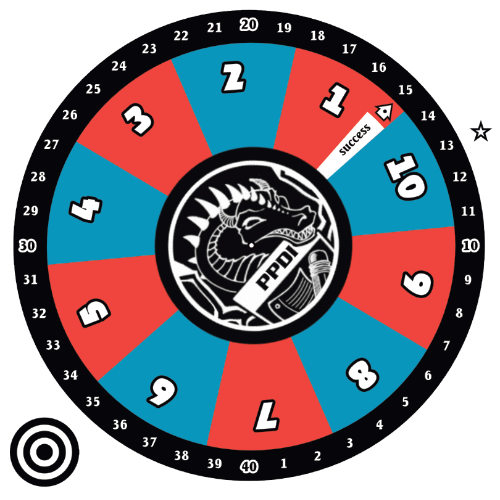
So if the wheel is pointing at 15? A 16 or 17 is a half success. An 18 is a single success. A 22 is a double and so on. With high strength values the C becomes eight successes, and the F becomes nine.
Turn the dial to point at 10 and the wheel becomes a success table. Anything in the 1/2 wedge or the purple space below it is a half success. The F wedge is a failure. The C is a crash.
Competitions With a competition you aren't trying to beat the other guy's strength so much as create the best strength possible. If you have ten characters competing, they all make an ability checks and whoever produces the greatest strength wins it. When winners tie for first place, each should roll a . Whoever rolls the greatest number wins by a hair.
With teams of characters competing (as in a tug-o-war) forget strength values and focus on success. Each character should make the same check, trying hard when desired. Tally up the number of successes rolled. A failure removes one success from the total. A crash removes two. In the end, the team with the greatest number of successes wins the competition.
Dungeons
A dungeon is any enclosed area — a decrepit castle, lost caverns, a haunted forest — where you might not want to linger for too long. In the days of yore, someone in the party would be designated the party Mapper and given a pad of graph paper to draw out a map of the dungeon on. A large chunk of the game was spent listening to the DM tell the mapper what to draw as the party wormed its way through the dungeon corridors.
This put the crawl into Dungeon Crawling.
Ghost Maps To keep the game moving, Dragonhead uses Ghost Maps which are skeletal copies of the maps that the DM uses with all of the secret stuff erased. Ghost maps are disposable! They are made to be drawn on. A ghost map will give you the general layout of the dungeon but you won't actually know what lies within until you go there.
Marching Order The first thing you should do is establish a marching order to show us who is in front, who is in the middle and who is guarding the rear. Use miniatures if you have them. Otherwise write the character's names down on a sheet of scrap paper to show their arrangement.
Ghost maps are measured in Squares, each representing 10 feet of space. Nine steps fit inside each square. Inside each step can fit one character. So most marching orders will fill something like a tic-tac-toe grid. If you have more characters in the party than can fit in a single square, they should spill into the square behind the party, not off to the sides.
Movement Speed Pick an entrance to the dungeon on the ghost map and mark its square. Next choose the speed at which the party will travel: Slow, Medium or Fast.
| Speed | Squares | Ramifications |
| Slow | Move x 2 | Searching or Hiding is Possible. |
| Medium | Move x 4 | No Searching or Hiding. |
| Fast | Move x 6 | Double Random Encounter Roll. |
Dungeon exploration moves in Crawls, each of which is 1 minute long. The number of squares you can move across the map in one crawl depends on the movement speed of the slowest party member.
So if the slowest character has Walk 3 then you can move 6 squares at slow speed, 12 squares at medium speed, and 18 squares at fast speed.
Slow speed is what you use when searching an area or trying to find a place to hide.
Medium speed is the party trying to move as fast as they can while still moving quietly. No searching or hiding is possible.
Fast is the party high-tailing it through the dungeon. No searching or hiding is possible. Because fast travel makes a ton of noise, the DM will roll twice on the random encounter table and use the lower of the two rolls to see if you encounter anything. With random encounter tables you do not want the DM rolling low.
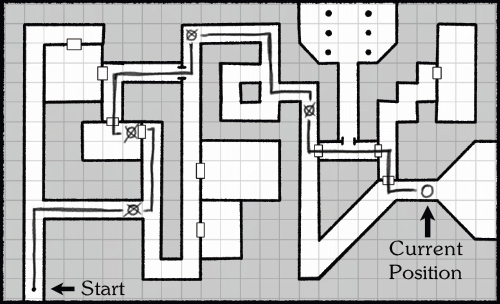
Tracing A Path The mapper uses a pencil to draw a line across the ghost map, keeping track of where the party has been. It takes two squares of movement to move diagonally. Draw a circle in the square where the crawl comes to an end.
Random Encounters At the end of each crawl the DM rolls on the dungeon's random encounter table to see if anything happens. Random encounter tables vary from place to place but they all come with the possibility of nothing happening, so you won't always encounter something every time the dice are rolled.
When something does happen and it isn't obvious where the encounter is coming from the mapper should roll 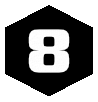 with the following table. Roll
  when left and right are not options. Roll at a t-intersection, turning Before into Right.
| Roll | Direction |
| 1 to 2 | Behind |
| 3 to 4 | Before |
| 5 to 6 | Left |
| 7 to 8 | Right |
Light How far away the encounter is depends on your light source. The Light aspect tells us the number of squares a light source illuminates beyond the square it is in. Random encounters appear inside that last square of light.
Torches have Light 3, so a random encounter will appear three squares away from a party travelling by torchlight. Candles have Light 1, so a random encounter will appear in a square adjacent to the one the party is in.
If the party has no light source then the creature will hit them with a surprise attack (no wisdom check necessary). In a lighted area, or with a party that can see in the dark the monster will appear around the nearest intersection or coming out of the closest door.
No matter what happens, after the encounter is over the mapper should mark the circle where the last crawl ended with an X and start drawing out a new crawl from a square adjacent to it.
Rooms Room encounters are planned encounters marked on the DM's map but left off the ghost map. Stumble into one and it happens, just like a random encounter, bringing your crawl to an untimely end. Mark that square with a circle and handle it. Once done, X out the circle and start a new crawl.
This assumes you are returning to the square where the previous crawl ended. If not the case, simply start crawling from wherever you are on the ghost map at the time you decided to start crawling again.
Searching You can only search an area while moving through it at slow speed. Everyone should make a Wisdom check, if anyone can beat the strength of something hidden in that area they spot it.
So when a secret door has been hidden with a strength of 13 anyone who can beat a 13 will spot it. Focusing your search by describing how you are searching, where you are searching or what it is you are searching for should make the check easier.
Traps Traps are mechanical devices designed to make characters regret their life choices. They will often be hidden with a secret strength that needs to be beaten while searching an area to detect it. When that happens the party can avoid the trap or intentionally set it off to disable it.
When the party doesn't find a trap, everyone should make a Luck Save. Whoever fails with the worst strength will be attacked by it. As if hit by a surprise attack from a creature, defend with DC.
With pit traps, anyone failing the Luck Save falls into the pit. Anyone who half succeeds will grab the pit's edge but now be dangling there, hanging on by their fingertips. They need one success or more with a Muscle check to pull themselves up. Other characters can help them by making a Hard Muscle check and adding their strength to the dangling character's muscle strength. Pit traps do falling damage determined by their depth and what is at the bottom of the pit (see Falling in Adventure).
No matter what kind of trap it is, when everyone makes their Luck Save the trap was somehow missed and remains undetected, liable to catch the party again the next time they wander through.
Hiding At the end of a crawl you can hide from a possible encounter, but only if you moved at slow speed during the crawl and told the DM you were looking for a place to hide. You cannot hide and search an area at the same time.
It's one or the other.
Everyone should make a Wisdom check to find the strength at which they hid themselves. How much stuff there is to hide behind and describing how you are hiding may change the difficulty of the check.
Creatures in a random encounter should be given the chance to spot hiding characters by making a Wisdom check. If none can beat the character's hide strengths they won't notice them. The party may launch a surprise attack or let the creatures wander on by.
If the monsters notice the characters they may attack or intentionally decide to leave, possibly to go set an ambush of their own or gather reinforcements. While checks are often rolled out in the open, you should never know what the other party has rolled until it's too late.
Doors Doors often come with a number of strengths in parenthesis, such as: Hidden Locked Door (secret 12, break 15, locked 13, hear 10). Typically one simple door is used by the entire dungeon and exceptions to it are noted where they happen.
| Secret | = beat with Wisdom to discover the door. |
| Break | = beat with Muscle to break down the door. |
| Locked | = beat with Dexterity to pick its lock. |
| Hear | = beat with Wisdom to listen through it. |
Up to two characters can combine forces when it comes to breaking down a door but both make Hard Muscle checks to do so. With a battering ram up to six characters can combine forces in this way.
Lockpicks are required to pick the lock on a door. Anyone who purchased the picks should know how to use them. Anyone who just found the picks somewhere will not. Characters wearing helmets might want to take them off as it makes hearing through a door harder to do.
Resting To take a rest you need to hold up in a secure location and spend a crawl doing nothing but catching your breath. The DM will roll for a random encounter. If something happens then your rest was interrupted. If nothing happens, each character should make a Constitution Save and recover wear damage per success.
When you do get to rest, be sure to mark it as a rest taken on your character sheet. The first three rests will be easy ones. The last three are hard ones. You can only take up to ten rests per day. You also gain experience points to the tune of 10 XP per 1 Wear recovered.
Party Splitting Common knowledge dictates that you should never split the party, but Dragonhead is a real playing game. If you can do it in real life you can do it here.
By splitting the party you form two or more parties who go on separate ways through the dungeon. At the end of each crawl the DM should make separate random encounter rolls for each party.
Even when the parties are within sight of each other, separate random encounter rolls should be made for each party. This can dramatically increase the amount of trouble the whole party runs into, which is as good a reason as any to never split the party.
Combat
Combat moves in rounds which are just three seconds long, time enough for your character to make one action — one thing you want to do — which can be anything we can imagine the character doing in three seconds or less. Most of the time this boils down to Move and Attack. First though, we need to figure out who goes first.
Initiative
When a fight breaks out roll for Initiative.
Roll 2, 4, 6 and the characters win it. The player sitting to the DM's left goes first and the game circles clockwise around the table with each player making their character's entire action before the next player gets to go. The round ends with the DM's creatures retaliating against the characters.
Roll 1, 3, 5 and the creatures win it. The same thing happens except now the DM's creatures begin the round and the player sitting to the DM's right ends it. Initiative should be re-rolled at the start of each round.
Move When not using miniatures, tell the DM where you want to go. The faster your speed the more likely you will be to get there. If you are using miniatures, be sure to read the section on Miniatures to figure out how they work.
No matter what form of movement you are using (even Hop, Fly or Dig) you can run to make your character go faster. This doubles your speed but it also hardens any check you make which is not a saving throw. You may move in any direction at normal speed, but you can only run in a forward direction.
Attack You get 1 Attack per weapon or appendage per round. If all you have is a sword you get one attack with it. A sword and shield will likewise give you just one sword attack (your shield will be busy defending). A sword in each hand gives you two attacks, one with each weapon. A two-handed sword gives you just one attack, and so on.
| What You Have | Number of Attacks |
| One Weapon | 1 |
| Weapon & Shield | 1 |
| Weapon in Each Hand | 2 |
| Two-Handed Weapon | 1 |
You can use your attack to do other things, such as sheath a weapon, draw a different weapon, remove a helmet etc, but you can only do one thing per appendage. You cannot draw a sword and attack with it all in the same round.
Hit Vs AC An attack is a Hit vs AC challenge. Every success you score does a roll of damage. A half success does a single roll split in half. The letter beside the damage roll tells us the attack's damage type.
| Letter | Damage Type | Ratio |
| s | Sharp | 1 : 1 |
| m | Mixed | 2 : 1 |
| b | Blunt | 4 : 1 |
| i | Impact | 6 : 1 |
Be sure to mention this, saying something like Eight Sharp for an attack doing eight points of sharp damage. Forget to mention the damage type and it defaults to Impact.
Body Size & AC/DC. When fighting anything with a body size larger than your own, you get a +2 to add to your AC/DC providing you remember it. Forget and the advantage is gone.
Defend After being hit by an attack, roll your Armor and subtract it from the incoming damage. If this reduces it to zero you take no damage. Otherwise, take the remainder.
If you have a Shield you should roll it along with your armor but only against attacks coming at the front or sides of your character. Shields do not protect your back.
Damage All damage is taken as wear damage. Damage type turns wear into tear. An attack doing 8 Mixed would do 8 wear and 4 tear.
Wear is recorded with a horizontal line through your damage circles. Tears use vertical strikes. Attacks bearing the Scar aspect do scar damage. They blacken a circle instead of striking it. Scar damage does not heal naturally.
Stunned Last but not least, when a single blow does your stun point or more in wear damage you lose your next immediate action to the shock of being hit. This could mean your action in this round if you have yet to go or the next round if you have already gone.
A stunned character trying to cast a spell will lose it. When grappling someone or desperately holding onto something you let go. A climbing or flying character plummets to the ground.
Taking double the stun point or more knocks your character flat. Now they lose one action to being stunned and need to waste another action standing back up. While you can make actions while flat on your back, they will be hard ones and you defend with DC.
On your character sheet mark a stun with an S next to your stun point. Mark a knock down with a K. Erase the letters as actions are spent to recover from them.
Shields A shield can be used as a weapon or armor but not both in the same round. So if you have not yet used your shield to defend yourself you may use it to make an attack (like a second weapon), but in doing so you cannot use it for defense for the rest of the round.
Considering that you can only make one shield attack per round but can defend yourself with it endlessly, most people are content to let their shield work as a shield and not attack with it.
Magic One spell may be cast as a character's attack for the round. Spell-casters and divine-casters need to use both hands and make a vocalization to do this. If they cannot do so the spell cannot be cast. Power-users have no such restriction.
Time is the number of rounds it takes to cast a spell. Fireball has Time 1 so every time you cast the spell one round needs to be spent waving your hands around and saying what needs to be said to bring it into being. If stunned during this time the spell will be lost.
Spells that do damage should be treated like weapons. AC/DC defends against them, Armor & Shield negate damage. Those that don't do damage will often have an ability listed as Save or Def in their aspects. These defend against the strength of the spell. Save means a saving throw should be made for it. Def uses a normal ability check.
No matter what a spell does or where it comes from, when you fail to cast the spell you forget it. X it from your attacks list. The spell can no longer be used until you spend some time (1 hour per spell level) recovering it. Crashing the cast does the same thing but with added impact from the Spell-Casting Crash table.
Magic items that need to be activated work just like spells. If the item has a time requirement, that is the number of rounds it takes to activate it. Potions have Time 3 so it takes three rounds to open the bottle, guzzle it down, and be enchanted by the potion's effects. You may move around while doing this but you cannot attack.
Communication When characters communicate during combat they can only say as much as their player can blurt out in three actual seconds or less. This should be done in character and just once per round (providing the character isn't using their mouth to cast a spell). Anyone replying to this utterance should realize that if they do so they will be using their shout for the round. Because it takes time to think, even characters connected by telepathy are restricted in this way.
In short, you can Move, Attack and Speak all at the same time, but you can't say a whole hell of a lot. Anyone you are speaking to can reply to what you have said, but only if they have not yet said something this round. This doesn't need to be be strictly enforced, but it is something to think about the next time two characters spend fifteen minutes debating what should be done in a round that is only three seconds long!
Encounters An Encounter is a very flexible length of time lasting as long as combat does or one minute. When a spell says it lasts for one encounter? That means it will last as long as you need it to or until the encounter is over.
A dungeon crawl lasts for one minute and is often considered one encounter long. In practice it is a bit shorter than that. Any spell cast while dungeon crawling will last into the random or room encounter that ends the crawl.
So if you cast invisibility on yourself while crawling through the dungeon your invisibility will not suddenly end once you enter a room. It will, however, end right after you are done handling whatever is in that room. Should the room prove to be empty you will need to cast the spell again to remain invisible as you enter a new crawl.
Minatures
You do not need miniatures to play Dragonhead but they do come in handy, especially with combat. Here are a few things you might want to have on hand before getting started:
- Miniatures — Paper, Plastic or Metal. One for each character and creature involved.
- A Vinyl Battle Mat — Covered in 1-inch squares, designed to be drawn on using dry erasable markers.
- Dry Erasable Markers — Do not use permanent markers. Sharpies are forever!
- Paper Towels — For cleaning the mat after a battle.
- A Small Tape Measure — For quickly measuring distances.
- A Mini-Mag Light — For lighting up areas.
Now, when a fight breaks out, the DM should quickly sketch the area onto the battle mat. Each space is known as a Step and roughly equivalent to a yard or meter for the characters involved. Nine steps fit inside each 10' square on the ghost map.
Find where the party should be according to the ghost map and their marching order. On the battle mat each mini should occupy a separate step.
Move Your movement is the number of steps you can take that round. You don't have to take every step but that is the most you can move.
When it comes to moving your miniature, you cannot move through a step occupied by another character or creature or a step adjacent to an opponent, not without making a slip-thru check first (see Slip Thru in Adventure). It takes two steps to move diagonally. You may pivot up to 90 degrees without problem. Every additional turn of 90 degrees more than that will cost you another step of movement.
A running character can move twice as much but doing so hardens any check they make. While normal movement can go in any direction, running characters can only go forward and turn up to 45 degrees per step. They may not pivot more than once on a single step.
Melee Attacks A melee attack can hit anyone you could reach while moving about. Normal and Close attacks can strike into an adjacent step. Those with a Reach aspect can reach as many steps as the number on the end of it. A Reach 2 attack can strike up to two steps away from a character. The catch is that a reach attack hardens when striking anything closer than its reach.
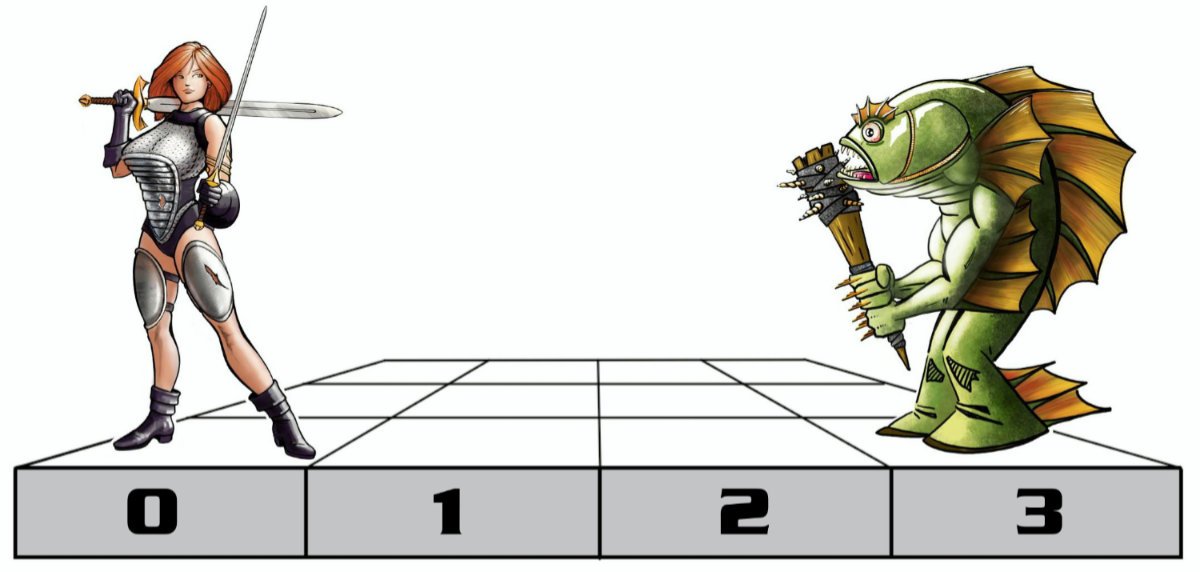
In the example above, Carmin is in step 0 and adjacent to step 1. Her swords are normal attacks and can attack anything in step 1. Spears have Reach 2 and with one she could strike into step 2 but still not be able to reach the Guppa. Halberds have Reach 3 and with one she could finally attack the fish thing.
There is no "Normal" aspect. Any melee attack that doesn't have the Close or a Reach aspect is considered a Normal one. Normal attacks have a hard time attacking anyone who is right on top of the character, aka in the same step. Close attacks do not.
Ranged Attacks In most dungeon rooms, a ranged weapon (such as a crossbow or bow) can attack anyone just as long as you can draw a clear line of sight between your character and the target. Anyone standing in the way should make a Luck Save. If it succeeds the shot barely misses them. If it fails they will be attacked instead of the target.
Outside, distances tend to be longer and may have a significant impact on ranged combat. When measuring distances use a tape measure where 1 inch = 1 step. Ranged weapons come with a range aspect, for example the short bow's Rng 20. Rng is short for range and 20 is its effective range in steps.
| Range | Effective | Max | Stunted |
| Point-Blank | 5 | 10 | 0 |
| Close | 10 | 20 | 0 |
| Short | 20 | 40 | 0 |
| Medium | 40 | 80 | 0 |
| Long | 80 | 160 | 5 |
| Extreme | 160 | 320 | 10 |
Effective is the number of steps inside of which you make a normal attack. A short range weapon is effective up to 20 steps away. If your target is inside that distance treat it like a normal attack.
Max picks up where Effective leaves off. Inside this range the attack hardens. Max is also the maximum range of the attack. A short range weapon will have a hard time hitting anything from 21 to 40 steps away. Beyond 40 steps the target is out of range.
Stunted only applies to Long and Extreme range attacks. Anything at this distance or closer becomes hard to hit by being too close. If an attack's Stunted range is zero you can ignore it.
Area Attacks Area attacks are caused by spells like Fireball that bathe an area in damage. The attack will have an aspect combining a shape with a radius. Fireball uses Blast 10. The shape of a blast is a full circle. Its radius is 10 steps.
To figure out who has been hit, hold your flashlight above the step the fireball detonates in. This is step zero. Now lift the light up and count off the steps as the light beam covers them. Once you reach 10 horizontally, every mini in the light will be hit by the blast.
Anyone straddling the edge of the beam should make a Luck Save. Succeed and they take no damage. A half success takes half damage. A failure takes full damage.
Stuns & Knock Downs In addition to everything that happens when a character is stunned or knocked down, with miniatures a stun will move a mini 1 step back away from the blow.
A knock down moves the mini 2 steps back and flips it on its side to remind us that it has been knocked down. When the mini is stood back up its player gets to decide which direction it will face.
Back Attacks Facing matters when dealing with miniatures! AC only protects the front and sides of a mini. DC protects its back. Likewise, a shield only protects the front and sides of a character, but not the back. Of course, if a creature has no discernable front or back then AC is used for all of it and it is probably not weilding a shield.
Retreat! You can use your normal movement to back away from a fight without penalty. Unfortunately, you can only run in a forward direction. To run away from a fight means turning your back to your opponent. They are not granted any extra attacks, but once they do get to attack they attack your backside.
Wilderness
Life is a journey, not a destination.
Unless your DM hasn't prepared a wilderness area for you to explore, in which case it is perfectly acceptable to say, "after a long arduous journey you arrive at...." and just zip about from place to place. Otherwise, give Wilderness Adventure a try. It's a lot like Dungeon Crawling but on a much larger scale. If you haven't yet read the section on dungeon crawling, feel free to do so now.
Where dungeon crawls use graph paper, wilderness adventure uses Hex Maps where each hex represents 1 mile of distance. A ghost map of the area should be provided by the DM for the mapper to draw on. Instead of one minute crawls, wilderness adventure uses 4 hour Jaunts. Much like dungeon crawling, for each jaunt the party moves a certain number of hexes across the map. A circle is drawn in the last hex the party entered. A random encounter roll is made, the circle X-ed out, and a new jaunt begins. This repeats until the party finally reaches its destination.
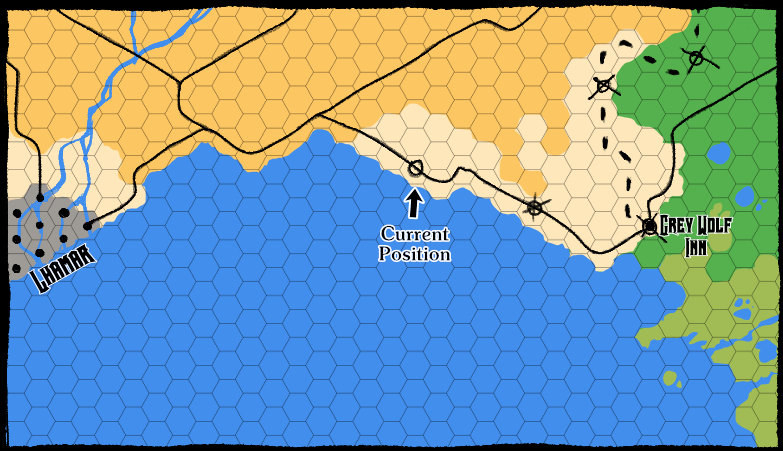
One mile may not sound like much but a one mile hex covers a vast amount of territory. You can move through the same hex multiple times and not see all of it. Where dungeons have a limited number of inhabitants, there is no real limit to the number of creatures that can inhabit a hex, so instead of crossing out encounters as they happen the DM often reuses them. You just ran afoul of a different band of roaming goblins.
Jaunts
A Jaunt is not just a measure of time but also a pattern of play. For each jaunt you should...
- Determine Your Speed.
- Roll for Weather.
- Move the Party.
- Roll for Exhaustion.
- Roll for Random Encounters.
1.) Speed As with dungeon crawling there are three different speeds a party can travel: Slow, Medium and Fast. The slowest member of the party determines how fast it will move. Mileage is the total number of miles you can travel in one jaunt.
| Speed | Mileage | Exhaustion | Ramifications |
| Slow | Move x 2 | +2 | Searching is Possible. |
| Medium | Move x 4 | +4 | Hard Searching is Possible. |
| Fast | Move x 6 | +8 | No Searching is Possible. |
Slow is an easy meandering hike. It is the least exhausting way to travel and you make normal Wisdom checks when searching the area you are travelling through.
Medium is normal walk speed. It can be exhausting. Hard Wisdom checks are made when attempting to search the area you are moving through.
Fast is double time. Everyone is huffing it to get to where they are going as quickly as possible. This is very exhausting and no searching is possible.
2.) Weather If the adventure comes with a weather table then by all means use it. Otherwise use the table below, exchanging rain for snow when travelling in winter.
| 1d100 | Weather | Exhaustion | Action | Speed |
| 40: | Clear | +0 | +0 | +0 |
| 30: | Drizzle | +1 | +0 | +0 |
| 20: | Shower | +2 | -2 | -2 |
| 10: | Downpour | +4 | -4 | -4 |
| 01: | Storm | +6 | -6 | -6 |
Roll 1d100 to find what kind of weather will dog the jaunt. Exhaustion is a modifier that adds to your exhaustion roll. Action is a penalty which applies to any check made during the jaunt (it does not apply to saving throws). Speed modifies the total mileage the party can travel.
Storms move quickly and it takes a Hard Wisdom check to examine the skies and accurately predict the weather. The party may set up tents to protect themselves, but doing so will cost them the entire jaunt as far as travel is concerned.
3.) Movement Maps should be color coded to indicate different terrains and use a Terrain Key to tell us how many miles worth of travel it takes to enter a hex of a certain type. For example:
| Terrain | Miles |
| Roads, Trails, Fields | 1 |
| Hills | 2 |
| Forest, Jungle | 3 |
| Mountains, Swamp | 4 |
Each hex represents a mile of distance but it takes two miles of travel to go through a hex of hills, three for a forest, and four for mountains. If you do not have enough mileage to enter a hex you cannot do so. After a jaunt, add any unused miles to the next jaunt.
Roads are drawn as a single line moving through a hex, so instead of drawing a solid line (the way we do when dungeon crawling) mark each hex with a dash to create a dotted line showing the party's path of travel. On a road, just mark the hex where a jaunt has come to an end. Be sure to X out the circle once finished so we don't lose track of where the party is at.
Jaunts end when either you run out of mileage or enter a hex containing an encounter. A bit like entering a room in a dungeon crawl, you may not have realized it, but the hex is marked on the DM's map and the DM will interrupt the jaunt to deal with it. If the encounter is a short one (lasting only a few minutes) the jaunt may continue after it, otherwise the jaunt will be brought to a premature end.
4.) Exhaustion Right before the DM rolls for an encounter, each character should make an Exhaustion and take it as Impact damage.
Exhaustion = Speed + Weather + Encumbrance + Climate
Speed. Start with the exhaustion caused by the party's movement speed. Characters riding a steed or in a vehicle start with zero.
| Speed | Exhaustion |
| None | +0 |
| Slow | +2 |
| Medium | +4 |
| Fast | +8 |
Weather. Next add any modifier brought on by the weather conditions.
Encumbrance. Add to it a modifier based on your current level of encumbrance, using the table below.
| Encumbrance | Exhaustion |
| Moving | +0 |
| Packing | +2 |
| Lugging | +4 |
| Trudging | +6 |
| Straining | +8 |
Climate. Compare your character's adjusted climate to the climate you are travelling through and add that to the total. A character outfitted for a Warm climate travelling through a Cold climate adds a +4 to their exhaustion.
| Climate | Torrid | Tropical | Warm | Temp | Cold | Frigid | Arctic |
| Torrid | +0 | +2 | +4 | +6 | +8 | +10 | +12 |
| Tropical | +2 | +0 | +2 | +4 | +6 | +8 | +10 |
| Warm | +4 | +2 | +0 | +2 | +4 | +6 | +8 |
| Temperate | +6 | +4 | +2 | +0 | +2 | +4 | +6 |
| Cold | +8 | +6 | +4 | +2 | +0 | +2 | +4 |
| Frigid | +10 | +8 | +6 | +4 | +2 | +0 | +2 |
| Arctic | +12 | +10 | +8 | +6 | +4 | +2 | +0 |
Body Size. If the character has a body size other than medium, multiply the total by its body size damage modifier.
Roll It! Turn the total into a die roll using the dice table. Roll the dice and take it as Impact damage. Armor and Shield do nothing to stop it. Note that characters will not be able to rest and recover before a random encounter happens. In extreme cases, exhaustion can kill. This is what is meant by dying from exposure.
5.) Encounters As with dungeon crawling, a random encounter can be anything but more often than not it will be a creature of some sort. Everyone should make a Wisdom check and the best should be used to see if the creature is spotted before encountering it.
| Best Wisdom | |
| 3: | Creature is seen in the Distance. |
| 2: | 2d6 rounds until Encounter. |
| 1: | 1d6 rounds until Encounter. |
| ½: | Immediate Encounter. |
| F: | Surprise Encounter! |
With three or more successes the party spies the monster in the distance and can easily avoid running into it. The creature will not see the party. With two or one successes, running into the creature is inevitable. We roll to see how many rounds the characters have to prepare for it. They may attempt to hide or even ambush the creature. With a half success the characters and creature run into each other without warning. With a failure or worse the creature catches the party off-guard and hits them with a surprise attack!
Reactions. Unlike a Dungeon Crawl the party is not necessarily invading a creature's lair so reaction rolls should be more common. Food is sparse in the wilderness. Having some to offer a creature should make reaction rolls easier. Being something that looks like an easy meal will make the reaction roll harder.
Resting. After an encounter is over the party may rest as long as they want before starting the next jaunt. The time this takes will not effect the four hours a jaunt represents.
Camping
By being 4 hours long, six different jaunts divide the day:
- Morning
- Afternoon
- Evening
- Night
- Late Night
- Early Morning
The first three happen in daylight. The last three happen at night. Because this can dramatically change the random encounter tables being used, most parties choose to travel during the day and sleep at night. Even though you are choosing not to travel while camping, the jaunts still happen, complete with exhaustion rolls, random encounters, weather, etc. Timewise, one jaunt is spent setting up, eating meals and breaking camp. Two jaunts are spent sleeping.
Guard Duty When camping it is always a good idea to leave someone standing guard while the others sleep. Should an encounter happen, only those standing guard get to make Wisdom checks. Don't forget about Vision! Working by the dim light of the moon or a campfire will make for Hard Wisdom checks. Dealing with complete darkness makes them even harder.
First though, all guards should make a Spirit check to see if they can stay awake. Anyone rolling a failure or worse has nodded off. If no one is awake to alert the party the creatures get to hit them with a surprise attack!
Foraging
To avoid dehydration and starvation at least one meal needs to be eaten per day (see Food & Water in Adventure). This is usually done right before going to sleep while camping. Of course, if the party has no food or water then they are going to need to spend a jaunt foraging. Instead of travelling you spend four hours pecking about the hex the party is in looking for anything that can be eaten. Once again Wisdom saves the day, or perhaps not:
| Hard Wisdom | |
| 3: | 3d6 meals are found. |
| 2: | 2d6 meals are found. |
| 1: | 1d6 meals are found. |
| ½: | Try again. |
| C: | Food Poisoning! |
Terrain does matter when it comes to foraging. It is far harder to find food in a desert than a forest. Telling the DM what you are looking for and having it make sense should make the check easier. What you actually find (fish, pheasant, rabbit, berries, skunk cabbage, etc) is left to the imagination. The point is that you found enough foodstuffs to make a few meals for a medium-sized character. Non-medium sized characters will need to eat their Size Mass in meals to make it count.
Food Poisoning Not everything out there is safe to eat. Rolling up food poisoning means you found 1d6 meals of poisonous stuff. Everyone should make a Luck Save anyone failing it eats it.
Roll 3d6 to find the strength of the poison. To find the nature of poison roll on the following table. Look up Poison in the Core Rules for more on this.
| Roll 1d10 | |
| 1: | Lethal |
| 3: | Knock-Out |
| 5: | Paralytic |
| 7: | Hallucinogen |
| 9: | Intoxicant |
Getting Lost
Getting Lost is a common random encounter. When it comes up, everyone makes a Hard Wisdom check. If no one succeeds the party becomes lost. Every time they go to move, roll 1d6 with the diagram below to find the direction in which the party actually travelled. Continue doing this until you run out of mileage.
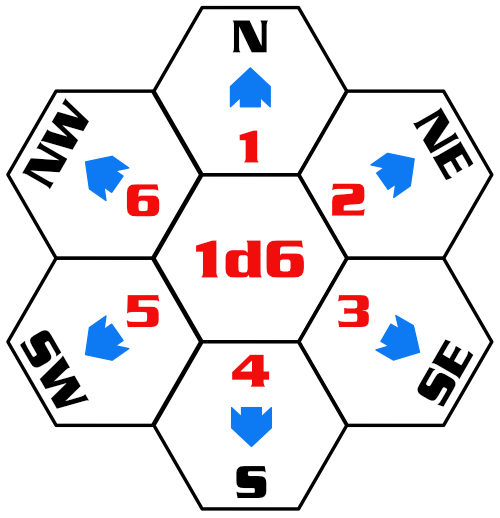
In the following jaunt another round of Hard Wisdom checks should be made — if no one succeeds — the party remains lost and moving at random. This continues jaunt after jaunt until either someone makes the wisdom check or the party stumbles into a hex marked by a road, trail, river or obvious landmark.
If the characters possess an actual map of the area (not the ghost map) they make normal wisdom checks instead of hard ones. If the map has a quality bonus, add it to their wisdom checks.
Big Country
Sometimes you need to travel vast distances and a scale of one mile per hex just isn't going to cut it. You might find yourself with a map that uses 5 or 10 miles per hex. The good thing is that wilderness adventure does scale. Travel still moves in jaunts. It just takes significantly more miles to enter each hex. With a map where each hex represents 10 miles it takes 10 miles of travel to enter a road hex, 20 miles for hilly terrain, 30 miles for forest, etc.
Daily Travel Once you get above 10 miles per hex, it is best to switch to a simpler form of daily travel. Instead of dealing with individual jaunts we treat the entire day as a single jaunt:
- Speed: Multiply your move speed by the number of hours spent travelling. Slow travel cuts the mileage in half. Fast travel increases it by half.
- Weather: one roll is made for the entire day.
- Movement: is handled normally, going from hex to hex, as far as your mileage will allow.
- Exhaustion: one exhaustion roll is made per day. Speed of travel also determines its damage type: Slow = Impact. Normal = Blunt. Fast = Mixed.
- Encounters: one encounter roll is made right after the exhaustion roll. Roll 1d6 to find when it happens. 1: Morning. 2: Afternoon. 3: Evening. 4: Night. 5: Late Night. 6: Early Morning.
Ocean Travel The most common way to travel vast distances is by boat. Boats travel just like characters with a few notable differences. First off, the boat's move speed determines how fast the party will move (instead of its slowest member). Boats also tend to have two forms of movements: Sails and Oars, both of which need to contend with the matter of windspeed which should be rolled right after weather.
| 1d100 | Wind | Sails | Oars | Capsize |
| 1: | Dead | x 0 | x 1 | None |
| 30: | Calm | x 0.5 | x 1 | None |
| 50: | Steady | x 1 | x 1 | Easy |
| 80: | Strong | x 1.5 | x 1 | Normal |
| 90: | Fierce | x 2 | x 1 | Hard |
| 95: | Howling | x 3 | x 1.5 | Double Hard |
| 98: | Raging | x 4 | x 2 | Triple Hard |
If the wind isn't dead you should roll 1d6 to find the direction the wind is blowing (it's the same table used by Getting Lost).
1: North. 2: North-East. 3: South-East. 4: South. 5: South-West. 6: North-West.
When travelling with the wind at your back (or one hex face to either side) the wind speed multiplies the ship's Sails or Oars speed. When travelling against the wind, roll 1d6, multiply it by the wind speed and subtract that from your movement (this only effects Oar speed with a Steady or stronger wind). You cannot sail directly into the wind.
Capsize is an Intellect or Wisdom check made by the captain of the vessel and hardened by the wind speed. Dropping your sails and travelling by oars will ease the capsize check. Only when it hits None does the check not need to be made.
| Capsize | |
| Intellect or Wisdom | |
| 1: | Remain Upright! |
| ½: | Try Again. |
| F: | Keel Over. |
| C: | Sink to the Bottom! |
If the ship remains upright it can continue to travel. Keel over means it is either on its side or upside down in the water. Characters can grab onto it to stay afloat but that boat is not going anywhere. Sink to the bottom sends that ship to a watery grave. Let's hope the characters can swim.
Adventure
By now you should have a good idea of how the game is played. On the whole, we like to leave as much to the imagination as possible, but there are a few situations which call for some additional definition. This is what the Adventure section is for.
Keep in mind that you do not need to know every rule to play the game, just a general understanding of how Dragonhead works and a willingness to look things up or make things up as needed.
Making Things Up Believe it or not, no one was shot at to figure out the rules for Cover. We got out some characters, rolled a few dice, thought about it for a bit, adjusted the rules, and thought about it some more. The process was repeated until finally something resolved which wasn't too convoluted and seemed about right.
That word Seem is important. It means that the ruling seemed right by way of what we know of reality and what the game mechanics will support. Think of it as your imagination's stamp of approval. When something seems right that's a good sign. Otherwise it's back to the drawing board.
No Do-Overs With all of this said, keep in mind that our time at the game table is precious and the game only moves forward. If you suddenly realize that a battle would have gone differently had only you known about Cover, no we cannot go back and do it again. Just try to remember it next time. Through hindsight is how much of this is learned.
Area Attacks
An area attack floods a space with damage, such as dragon's breath or a fireball. Anyone caught in it will be hit by the same amount of damage. AC / DC is ignored. Armor & Shield does defend against it.
Area Shapes Areas come in different shapes identified by a term such as Cone or Wall. When looking down from above, possibly with a beam of light shining on some miniatures.
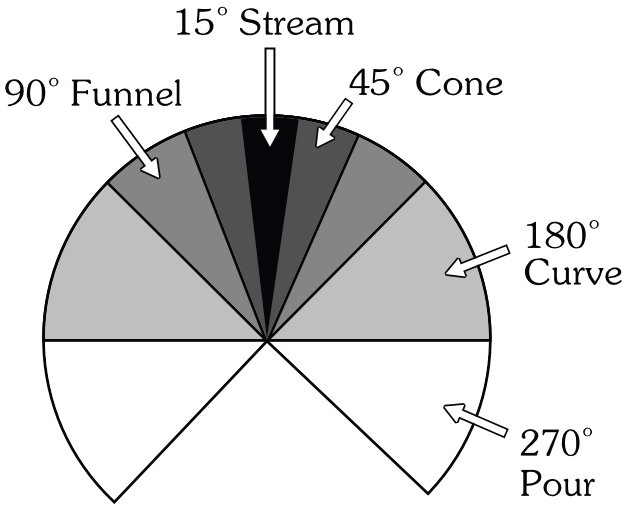
| Blast | = hits a full circle |
| Stream | = a 15° angle |
| Cone | = a 45° angle |
| Funnel | = a 90° angle |
| Curve | = a 180° angle |
| Pour | = a 270° angle |
| Cloud | = a projected circle |
| Dome | = a bubble |
| Cube | = a full square |
| Torus | = a doughnut |
Area Size The number attached to an area is its radius. This is the number of steps it extends beyond the step the attack originated in, for example:
| 0 | = Dinky |
| 1 | = Small |
| 3 | = Medium |
| 6 | = Large |
| 12 | = Big |
| 24 | = Huge |
| 48 | = Massive |
If the area doesn't have a size then its radius is equal to the damage done divided by 5 and rounded down. An area attack doing 30 points of damage has a radius of 6.
Blast A blast is essentially a sphere radiating out in all directions. An explosion with Blast 0 is like a firecracker. It hits anything occupying the same step as itself. A Blast 2 hits that step as well as everything two steps around it.
Stream With miniatures, a streaming attack shoots forward in a line, hitting everything that crosses its path. Without minis a streaming attack can hit 2 different targets per success.
Cone, Funnel, Curve, and Pour With these step zero is the step occupied by the character creating it. They attack an ever-widening area the farther they fan out.
Cloud A cloud attack is like a Blast except instead of billowing out around the point of detonation this one projects forward one length of its radius and billows out around that point. This should protect the cloud's creator from being hit by it.
Cube A cube forms a square space that is as high, wide and deep as its size. A Cube 3 starts with 3x3x3 as its dimensions but it can be scrunched into different shapes such as a wall with 4x4x1 or a beam with 1x1x7, just as long as the three dimensions add up to triple the cube's size in steps.
Torus A torus is essentially a giant doughnut. It goes off like a blast but leaves step zero unharmed. This protected core can be widened without penalty but doing so does not change the overall size of the torus.
Dome A dome is a sphere whose sides drape to the ground. It covers everything as tall as the sphere including the ground beneath it. Up in the air it forms a bubble. Domes are more often used for defense than offense. You measure it to see who is covered by a spell rather than who is hit by it.
Armor Sacrifice
Armor Sacrifice lets armor or shield take tear damage instead of your character. It has no effect on wear damage but you can subtract from the defensive value of a piece of armor or shield any tear damage heading towards your character. A medium shield has a defensive value of 6 so it can absorb up to 6 tears of damage before being rendered useless.
You should record this by changing the dice roll on the front of your character sheet as well as the values in your equipment. Armor Sacrifice will send bits and pieces of armor flying but never enough to effect your Move scores, not unless you decide to chuck a now worthless helmet or shield.
Weapon Sacrifice This is a variant on the idea of armor sacrifice. Instead of taking a tear of damage one of your weapons takes a -1 hit penalty. This always effects quality first. A Sword +3 taking a tear of damage becomes a Sword +2. Any weapon that reaches -5 finally breaks and becomes useless.
The big catch with Weapon Sacrifice is that the weapon must be a melee weapon you are actively using. You cannot simply wear a belt full of daggers and use them to soak up damage. Ranged weapons may be sacrificed but as soon as they are damaged they break, usually due to something simple like a broken bow string.
Aspects
Aspects are tags attached to attacks and equipment. They are short-hand reminders of how things work. Most but not all are combat related.
1shot This item can be used once and never again.
2hds It requires two hands to work.
Activate This is the score you check to activate a magic item.
Ammo The number of shots a weapon can take before needing a reload. Natural attacks that use ammo, such as dragon's breath, reload as the creature sleeps. Weapons that need to be reloaded every time they are used will not have an ammo count.
Bastard A bastard weapon is a one-handed melee weapon made with an elongated grip so it can be used with two hands when needed.
When used with two hands it gains Damage +2. Using a non-bastard weapon with two hands only gives it Damage +1.
Turning a weapon into a bastard weapon increases its price by 25% and adds 1 lbs to its weight. Be sure to attach Bastard to its name, such as Bastard Sword or Bastard Mace.
Weapons that have Bastard as an aspect, such as the spear, are made for one-handed use but can easily be used with two hands for a +2 damage bonus.
Bal Bal stands for Balanced. Any melee weapon can be thrown at Point-Blank range but this hardens the hit. Balanced weapons suffer no such penalty.
Burst This attack fires off a machine gun like burst. The die roll tells us the number of shots that hit its target (see the Burst rules below).
Close This attack was made for fighting in close quarters.
Cold This attack will flash freeze an opponent in place. The character needs to beat the strength of the attack with a Muscle check to break free.
Using a weapon to hack away at the ice makes the Muscle check easier, but crash the check and you hit yourself for one success of damage and half armor protection.
Def This is the ability an opponent defends themselves with against the attack.
Dur Dur is short for Duration. It tells us how long something lasts. A number is a number of rounds. A PS stands for Per Success. A spell with Dur 5 PS lasts five rounds per success.
Dur Enc This spell will last for an entire encounter. Basically, it lasts until the fight ends.
Dur Conc This spell lasts as long as its caster concentrates on making it last. Being stunned or trying to do something other than move around dismisses it. You may not run and concentrate at the same time.
Elec This is an electrical attack. Any opponent wearing metal armor defends with DC against it.
Fire This attack stands a chance of setting a creature on fire (see the Fire rules below).
Fragile The item is easily broken and/or Italian. Any time a character carrying it falls or is knocked to the ground a Hard Luck Save should be made. Fail and the item breaks.
Grapple This attack simultaneously does damage and grapples whoever it hits using the strength of the hit for the grapple (see Grappling below).
Great Like Bastard, this aspect is normally found attached to the name of a weapon. It is a one-handed melee weapon made larger and two-handed. It gains Damage +4, takes a Hit -1 and requires two hands to use.
Making a weapon great increases its price and weight by 50%. Be sure to attach Great to its name, such as Great Sword or Great Mace.
HD Half Defense. Any armor or shield roll made against this attack will be cut in half.
Light This is the number of 10' squares a light source will illuminate beyond the one it is in.
NAN No Activation Necessary. The item is magical but does not require an activation roll. It is always on.
ND No Defense. Armor and sheild do not protect against this attack.
Poison The number attached to this aspect is the strength of the poison. It may be further described such as Poison Paralytic 14 for a poison with a strength of 14 that paralyzes whoever cannot defeat it. If nothing is mentioned the poison defaults to deadly.
Reach These attacks have the benefit of reach. The number attached to it is the number of steps away from its wielder that it can reach. Reach 2 attacks up to two steps away. Unfortunately, reach weapons harden their hit rolls against anyone standing inside the reach distance (see the Melee Combat in Miniatures).
Rng Rng indicates a ranged attack. The number is its effective range, i.e. the distance inside of which the attack operates without problem. Double that number is its maximum range. A weapon with Rng 20 has no problem hitting anything from 1 to 20 steps away, a hard time hitting anything 21 to 40 steps away, and cannot hit anything 41 or more steps away (see the Ranged Combat in Miniatures).
Rld Rld is short for Reload. Just a number tells us how many rounds it takes to reload the weapon.
Save The ability following Save is what you use to make a saving throw that defends against this attack.
Scar This attack does scar damage. Every tear of damage should be blackened in instead of struck. Scar damage does not heal naturally and is hard to heal magically (see the Healing below).
SEP Single Effect Power. A character can only be effected by this power once. Casting a spell like Haste on a character multiple times does nothing except replace the most recent cast with a new one.
SL Size-Locked. This item is always medium-sized.
SUP Single Use Power. Future casts of this spell dismiss earlier casts of it. The spell Curse lasts until its caster casts Curse again. The new spell dismisses the old one, freeing whoever the curse was cast upon.
Time This is the amount of time it takes to cast a spell or commit some kind of action that cannot be pulled off in a single round. A number like Time 3 is a number of rounds.
During this time the character can do nothing but work on committing the action. If stunned or otherwise distracted the attempt will be lost and the character will have to start over.
Once the time requirement has been fulfilled a check for it can be made in the following round. So a spell with Time 1 can be cast every other round with the in-between rounds spent preparing for the next cast.
Touch To use this power a character must physically come into contact, skin to skin, with what it effects.
Body Size
While characters and creatures come in thousands of different sizes, we narrow it down to sixteen general body sizes to make the matter easier to handle:
| Size | Mass | Dmg | Dis | Ex | Hide | Example |
| Tiny | 0.1 | 0.2 | 0.4 | 1/4 | +8 | Field Mouse |
| Little | 0.3 | 0.4 | 0.6 | 1/4 | +6 | House Cat |
| Compact | 0.5 | 0.6 | 0.8 | 1/2 | +4 | Farm Dog |
| Small | 0.8 | 0.8 | 1 | 1/2 | +2 | Young Human |
| Medium | 1 | 1 | 1 | 1 | +0 | Adult Human |
| Large | 1.5 | 1.2 | 1 | 1 | -2 | Hobgoblin |
| Extra | 2 | 1.5 | 1.2 | 1 | -4 | Bugbear |
| Big | 4 | 2 | 1.5 | 2 | -6 | Ogre |
| Huge | 6 | 2.5 | 2 | 2.5 | -8 | Hill Giant |
| Massive | 10 | 3 | 2.5 | 3 | -10 | Fire Giant |
| Enormous | 15 | 4 | 3 | 4 | -12 | Storm Giant |
| Humongous | 30 | 5 | 4 | 5 | -14 | Mammoth |
| Colossal | 60 | 7 | 5 | 7 | -16 | Kraken |
| Gigantic | 100 | 10 | 7 | 10 | -18 | Epic Dragon |
| Titanic | 300 | 15 | 10 | 15 | -20 | Leviathan |
| Gargantuan | 500 | 20 | 15 | 20 | -22 | Ancient Dragon |
Mass Mass is a multiplier based on the size of the character. A Big creature has four times the body mass of a medium-sized one. Things made for it will weigh four times as much. A Compact creature only has half the mass of a medium sized character. Things made for it will only weigh half as much and be half as large.
Mass multiplies muscle strengths during play. It multiplies the character's base load. The amount of food a character needs to eat to keep from starving should be multiplied by mass as well.
Mass also effects the price of items made to fit a size greater than Medium. It does not change the price of anything made smaller than Medium. Sorry, no discounts for the little people.
Dmg Dmg multiplies damage. It multiplies physical damage, Hit Points and Stun Point. It multiplies the amount of damage you repair through rest and recovery. For those with a body size of Big or larger it multiplies the amount of damage try hard does to your character (see Ex below).
For combat, Dmg multiplies damage done by weapons and spells. It also multiplies the defensive values of armor and shields. Note that all of these multiplications should have been made when the character was created and do not need to be made while playing the game. Unless, of course, the character somehow changed sizes during the game.
Dis Dis multiplies anything having to do with distance, such as movement speeds, weapon ranges, area sizes, etc.
Ex Ex is short for Exhaustion and is the base amount of damage you take when trying hard. A huge creature has Ex 3 so it takes 3 points of wear when it tries harder and 6 points when trying its hardest.
The Small and Compact sizes use half points for exhaustion. The Little and Tiny sizes use quarter points. The easiest way to record a half-point is to put a dash on one side of a damage circle instead of drawing a line through it entirely. For quarter points, divide the circle into quarters and mark them, almost as if you were X-ing out the circle instead of drawing a line through it.
Hide Hide is a modifier that effects a character's attempt to hide. It also effects Diving For Cover to avoid an explosion.
Muscle Muscle scores are not multiplied by Mass, only the final strength you use during play is. Keep this in mind when creating a character. All of those things effected by your muscle stay at medium-size. This includes your MM or muscle modifier. Instead of changing your MM, body size Dmg multiplies the entire damage done by an attack.
Different Sized Opponents Any time you fight someone with a body size that is larger than your own you gain a +2 to your AC/DC, your defense against being grappled, and your ability to slip past opponents (see Slip-Thru).
Essentially the size difference is making you a hard target to hit. It is something you need to remember and bring into the game. Forget the bonus and you don't get it!
Burst Attacks
A burst attack is one that fires off a machine-gun like volley of missiles. The die roll following the Burst aspect is the number of shots that hit its target. When ammo matters, the number of shots fired is equal to the best number on the burst die. For example:
| Light | = Burst |
| Small | = Burst |
| Medium | = Burst |
| Large | = Burst  |
| Heavy | = Burst 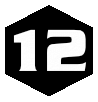 |
After rolling to hit, roll the burst die. Each shot does the same amount of damage to the target. But! Armor and shield defend against each shot as if they were separate attacks. Last but not least, combine the amount of wear damage done by the entire burst and use that to figure out if the character has been stunned or knocked down.
Spreading the Burst You can fan a burst out over an area but doing so will impact your burst roll:
| Tight concentration (15° angle) | = -1 |
| Loose concentration (45° angle) | = -2 |
| Wide spread of fire (90° angle) | = -4 |
A medium burst spread over a wide area rolls a 1d8-4. Any roll less than 1 spreads the burst so thin it misses everything. Otherwise, everyone in that area should make a Luck Save. Each target takes one shot. Start with the lowest luck strength and move up through the rest until the burst runs out of shots. Run out of targets first and you should cycle back to the lowest luck strength and do it over again until every shot has been accounted for. Because these targets will probably have different ACs each shot should be treated like a separate attack using the same hit strength.
Climbing
Climbing is a Dexterity check made difficult by just how intrepid the climb is, whether you have done it before, and if you are using climbing gear.
| Dexterity | |
| 1: | You made it! |
| ½: | Almost. Make the check again. |
| F: | Fall from half way up. |
| C: | Fall from all the way up. |
So if you are trying to climb a 40 foot cliff the more successes you land the quicker your ascent. With a half success you need to make the check again. Fail and you fall from 20' up. Crash and you fall the whole 40'. See Falling below to figure out the damage a fall does.
Cover
Taking cover means hiding behind something to protect your character. You do this as part of your Move for the round. There are two levels of coverage, each effects the difficulty of anyone attacking you.
Partial Cover All but a small part of your body is covered. You become a hard target to hit but may return fire with a ranged attack without problem.
Full Cover You believe yourself to be completely hidden behind something. This makes you a double hard target to hit but to keep it you cannot return fire.
Diving for Cover Against an area attack use your action to dive behind what you hope will protect you from the blast. Make a Dexterity check. Be sure to talk about the area you are in and what you intend to dive behind, this may make the check easier to perform.
| Dexterity | |
| 4: | No Damage. |
| 3: | Tenth Damage. |
| 2: | Quarter Damage. |
| 1: | Half Damage. |
| ½: | Full Damage. |
| F: | Double Damage. |
| C: | Triple Damage. |
Success determines how much damage you take. Armor and shield do protect against explosions but AC/DC does not.
Damage Type
Damage is a measure of force. Damage Type is what makes that force lethal.
- Sharp focuses the force onto a sharp edge, such as the blade of a sword.
- Mixed combines sharp edges with brute force. The morning star, a club covered in spikes, is a classic mixed weapon.
- Blunt focuses that force onto a small yet blunt area, such as the head of a mace.
- Impact spreads the force over a wide blunt area, such as the shaft of a quarter staff.
All weapons are designed to do a specific kind of damage. You may change the way you use a weapon to change its damage type but this will harden the attack.
Consider the spear. It does sharp damage by default, but you could hit with the capped end to do blunt damage or use its shaft like a quarter staff to do impact damage. The drawback is that spears are designed to stab things. All other uses are harder to hit with.
Disarm
Sometimes you just want to knock the weapon out of your opponent's hand. This is a Hard Hit vs Dexterity Save challenge. The number of successes you score determines what happens next:
| Hard Hit vs Dexterity Save | |
| 4: | Ah-hah! The weapon flips gracefully through the air to land in your other presumably open hand. |
| 3: | Thwanggg! The weapon flies across the room to stick into something with an impressive noise. |
| 2: | Knocked Free. The weapon is knocked free of your opponent's hand and drops to the ground. |
| 1: | Lock Weapons. Your weapons lock together. Your opponent loses their next immediate action to breaking free. |
| C: | Whoops! Your own weapon goes flying across the room. |
Disarm If the weapon you are using bears the Disarm aspect then it was made for this sort of thing. It takes just a Hit check instead of a Hard Hit check to disarm with it.
Two-Handed Weapons It is harder to disarm someone who has two hands on their weapons as opposed to one.
Unarmed Attacks You may disarm an opponent using just a Punch attack, but only if the weapon has a sizable area to grab onto such as a spear shaft.
Try as you might, there is no way to disarm an opponent of an unarmed attack since the attack is physically attached to their body.
Body Size The greater the size difference between you and your opponent the harder it will be to disarm them. Larger or smaller it does not matter. Each size difference makes it harder.
Divine Casters
Raging across the universe is a secret (and sometimes not-so-secret) war between the divine forces of Good and Evil. A character's alignment comes for the sum total of the actions they have taken in life and will unknowingly (or sometimes knowingly) place them on one side or the other of this cosmic divide. Those who do not belong to either side are Neutral, an alignment representing the default unaligned state of the universe.
Fickle Forces The divine forces that grant classes like the Cleric and Paladin their magical powers are always watching and can be quite fickle. No divine magic may be used to help the other side! So while healing the wounded is generally considered a good thing, a Good cleric who uses a healing spell on an obviously Evil character will draw the ire of their deities and that spell will fail. The same goes when trying to use magic to harm someone of the same alignment as yourself (yes, even when Evil). Anything Neutral is fair game.
Alignment Strength One way in which this divine war is waged is through acts of Consecration. When successfully cast on a place, the consecration grants it an alignment strength equal to the strength of the spell cast. Consecration cannot be seen but it can be felt. Anyone strongly opposed to that alignment cannot enter or even look at a consecrated area without first beating its alignment strength with a Spirit check.
Spell Casting Even moreso than spell-casters, divine-casters need to vocalize and gesticulate in order to cast a spell. If they cannot do both at full volume the spell cannot be cast. Unlike spell-casters, they may not do so at half volume to hide what they are doing.
Divine magic does not come from a character so much as through them from somewhere else. Because of this, when casting spells in an area consecrated to an opposing alignment, the spell strength needs to beat the alignment strength of the area or it will not go off. It will basically be barred from entering the area.
Lost Spells When a cast fails or crashes, the spell is lost and cannot be cast again until 1 hour per spell level is spent praying to get the spell back. Such praying cannot be done in an area consecrated to an opposing alignment. It speeds up to ½ hour per spell level when done in an area consecrated to the divine caster's alignment.
Doubt Crashing a divine cast will saddle that character with Doubt. They will have a hard time doing anything. The only way to be rid of this is to retreat from the world to study in solitude. At the end of each week a Spirit Save + Class Bonus check should be made (without the doubt penalty). Succeed and the doubt is lifted. Otherwise they will need to spend another week before they can try again.
Falling
The damage done by a fall is equal to the height of the fall in feet turned into a die roll. Armor and shield protect against it but only at half value. What you land on determines the damage type.
| Damage Type | Surface Examples |
| None | Water, Snow, Hay. |
| Impact | Grass, Dirt, Mud. |
| Blunt | Cobblestones, Slate Floor. |
| Mixed | Broken Timber, Jagged Rocks. |
| Sharp | Spikes, Stalagmites. |
Fall 10 feet into a pit full of spikes and you take  in damage. If you don't know what the surface is, make a Luck Save to find its damage type.
| Luck Save | |
| 2: | None. |
| 1: | Impact. |
| ½: | Blunt. |
| F: | Mixed. |
| C: | Sharp. |
Falling While Flying
Characters who are stunned while up off the ground (flying, gliding, climbing, etc) will plummet towards it. When we don't know how high they were but suspect they were at a hundred feet or less, roll to find the damage done.
Above that point a character should be given a Spirit Save for every 100' they fall. If any are successful the character shakes off the shock and may resume flying before hitting the ground. Otherwise roll for every 100' fallen to take as damage.
Fire
Anyone hit by an attack bearing the Fire aspect should make a Luck Save to see if the character has been set on fire.
| Luck Save | |
| 1: | Nothing Happens. |
| ½: | Fire Damage  per round. per round. |
| F: | Fire Damage per round. |
| C: | Fire Damage per round. |
Fire damage should be rolled once at the end of each round until the blaze is extinguished, including the round that started the fire. Armor and shield do not protect against it.
Using your action to do a stop, drop and roll lets you remake the Luck Save once per round. Diving into something like a pool of water puts the flames out instantly.
Resistant and Proof Certain spells and magical natures may make a character Fire Resistant or Fire Proof as well as Cold Resistant or Cold Proof. Resistant means any damage done by fire or cold is reduced by half. Proof means the character is perfectly protected and takes no damage from it. A fire-resistant character can be set on fire but a fire-proof one cannot.
Food & Water
Once per day you need to eat one ration and drink at least one pint of fluid to stave off starvation and dehydration. Otherwise, at the end of the day you take damage depending on what you missed.
Starvation =
Dehydration =
Obviously, armor and shield do not protect against this. If your body size is something other than medium the damage done should be multiplied by your Size DMG. The amount of food and water you need to consume should also be multiplied by your Size Mass.
Eating insubstantial food or fetid drink does half damage. A pound of body fat can be burned in place of a meal to avoid starvation. It takes a Hard Spirit check to do this intentionally when food is available.
Grappling
A grapple is when you grab an opponent and wrestle them into submission. Make a Muscle check as your attack, adding any bonuses you might have for unarmed combat. Whoever you are grappling should do likewise, possibly using Dexterity instead of Muscle if all they want to do is escape.
Muscle vs Muscle or Dexterity
If the strength of the grapple can beat the strength of the escape then the grapple succeeds. Both characters are stuck there, unable to move or do anything for as long as the grapple is held. DC defends against any attack headed their way.
Round After Round After a grapple is set the grappled character may try to escape it once per round. The grappler does not need to do anything to hold it at its current strength. The grappler may try to reset the grapple, hoping to get a better strength, but if they fail the check they lose the grapple.
Dog Piling Grappling isn't always between two characters. Multiple characters may enter the fray. Have everyone attempting to grapple someone make a Hard Muscle check and combine their strength scores. The grappled character needs to defeat this to break free.
Healing
Adventure is brutal, exhausting business and eventually you will need to recover from it.
Resting
Wear damage is easily healed. Stop to rest for a minute, make a Constitution Save and recover points of wear damage per success. Be sure to mark this down as experience points where 1 Wear = 10 XP.
The catch is that you can only rest ten times per day. Note the letters inside the rest circles on your character sheet. The E stands for Easy and your first three rests will be easy ones to make. The H stands for Hard and your last three rests will be hard to make. Mark them off as you use them.
In combat it takes 20 rounds spent doing nothing to rest, making it very hard to rest during combat unless you have been knocked unconscious. Unconscious characters start to rest on the round following the one where they hit the floor.
Sleep A full night of sleep (eight hours) recovers all wear damage and clears out your rest circles. Such sleep can only be had in a relatively safe place and you cannot sleep in your armor. Ignore either of these and you only recover half of your wear damage and rest count. Ignore both and you get nothing.
Long Term Healing
To heal tear damage you need to spend a week convalescing — doing as little as possible — and at the end of it make a Constitution Save. Now you recover in tear damage per success. A failure turns tears into scars. A crash means you died of gangrene.
Magical Healing The quickest way to heal damage is with magic. Everything that does so works like an attack in reverse. The damage it should do now heals wear and tear on your character. You do gain XP for magical healing. It does not count as taking a rest. Magic can be used to heal scars but all other damage need to be healed first and it takes 4 points of tear repair to heal one scar of damage.
While using magic to heal wear damage feels pretty good, using it to heal tear damage feels like rubbing salt in a wound, dousing the salt in kerosene and lighting it on fire. It is impossible to do anything for one round per tear recovered while this is happening. A white discoloration will cover the damaged skin and it may take months if not years for it to return to its normal color.
Beware those who come streaked in white!
Hirelings
Hirelings are NPCs and creatures you hire to accompany the party on an adventure, possibly to guide your way through the wilderness, fight on your behalf, or simply hold a torch.
Hiring Hirelings How much this costs per day depends on the level of the hireling, your character's Charisma and the hireling's Intellect (or lack thereof).
| Charisma vs Intellect | |
| 3: | $10 per level. |
| 2: | $20 per level. |
| 1: | $30 per level. |
| ½: | $60 per level. |
| F: | Sorry mate, no sale. |
| C: | Did you just insult my mother? |
Roll up one success while trying to hire a third level fighter and it will cost you ($30 x 3) $90 per day for their service. Hirelings will want at least a week's pay in advance or possibly more for longer journeys.
Loyalty During the adventure, any event outside of what the hireling signed on for (ex: being arrested, having magic used on them, starving from lack of food, etc) will be cause a loyalty challenge. This is a Charisma Save vs Wisdom pitting the employer's charisma verses the hireling's wisdom. It is a secret challenge. The employer will not know the outcome until it is already too late.
Rout, Run & Mutiny! A lost loyalty challenge will become apparent once the hireling takes the next best opportunity to disappear into the wilderness.
Good hirelings often sneak off into the night hoping to never run into the party again. They may even leave behind their advance as a token of good will.
Neutral hirelings will also disappear. Not only will they not return their advance but they may steal a few things on the way out.
Evil hirelings will not only steal and run but they may hang out in the wilderness, stalking the party, hoping to pounce on them as they return home, weak yet laden with treasure.
DM Controlled No matter how much force of charisma a character has over their hirelings, they are ultimately creatures run by the DM. Treat them badly, use them as meat shields, force hirelings to take risks a character is not willing to take and all agreements are off. The hirelings will quit on the spot and even the good ones may come seeking retribution.
Max Number of Hirelings? The only thing limiting the number of hirelings a character can have is the amount of money they have to spend on them. What works for a small party of adventurers also works for a continental army.
Rebellion! When it comes to large numbers of hirelings and the matter of loyalty, the DM should choose an NPC to represent the whole group. This will be a revolutionary leader actively instigating revolt against the employer.
Instead of a loyalty challenge there should be a Charisma Save Competition between the two. If the rebel leader wins, the rebels break away to become a separate faction under the rebel leader's command. Otherwise the rebel leader will be abandoned and have to flee. Everyone else will fall back inline.
Jumping
To jump over something substantial make a Dexterity check. Difficulty comes from just how far you have to jump and how intrepid the leap is. There is a big difference between jumping over puddles and leaping between roof tops.
| Dexterity | |
| 3: | You make it with a back flip or two. |
| 2: | You make it in style. |
| 1: | You make the leap. |
| ½: | You are on the other side dangling by your fingertips. |
| F: | GAHhhhhhhhhhhhhhhhhh-hhh!!!!! |
| C: | Splat. |
Any character caught dangling by their fingertips will need to make a Muscle check to pull themselves up. Others who are already on that side can help pull the character up by making a Hard Muscle check and adding their strength to that of the dangling character.
With Miniatures Jumping is different when we can see just how far the character needs to go. The distance a character can safely jump without a check is half its move speed.
Jump Distance = ½ Move Speed
Running up to the jump doubles your movement but it also forces you to make a jump check. This check will not be hardened by the fact that you are running, but anything else you try to do while making the jump will be hardened.
Two exceptions to this come from the Hop and Glide forms of movement. These get your full move speed instead of half. Anyone with the Fly form of movement should have no problem covering the distance without making a check.
Kicks
Kicks are a bit different from other attacks. They still abide by the 1 attack per appendage rule, but if you moved during the round then you used your legs and cannot make a kick. If you didn't move then you still need one leg to stand on and can only make one kick as your entire action. Your arms will be busy either holding a shield or helping you keep your balance.
Kicks & Grapples When caught in a grapple, you may make a kick attack (possibly kneeing an opponent in the gut or stomping on their foot) but it will always be a hard one. If you are maintaining the grapple and fail with your kick you let go of it.
Trample A trample is where you simply run someone over. This hits with one kick from every two legs. For stun purposes, add up the damage done by all the kicks and compare the total to the character's stun point as if it all came from one attack.
Being trampled by a human is essentially a kick attack. Being trampled by a horse is like getting hit by two kick attacks whose damage combines into one for the purpose of stunning someone or knocking them down.
Magic Items
Items bearing a quality bonus, such as a Sword +1, are not necessarily magical and will add that bonus never failing. Those that do something magical, such as a Wand of Fireballs, need to be activated to use them.
Activation! Point the item in the right direction, say its incantation, roll the dice and hope for the best. Success determines just how much magic comes pouring out. Nothing but a class that specifically mentions Activating Magic Items can help it. Use your Magic ability plus any quality bonus the item possesses.
| Magic + Quality | |
| ½: | It works! |
| F: | Nothing happens, try again next round. |
| C: | Item Destroyed! |
With a half success or more the item works as planned. Fail the activation and nothing happens. Try again next round. Crash the activation and the item is destroyed. Not only will it never work again but the DM gets to roll on the magic item crash table, which is never a good thing.
Magic Weapons If the item is also a weapon, such as a Sword of Flame, write it in your Attacks list with the hit score it uses as a weapon under Hit. In Aspects include its activation score using the aspect tag Activate.
Now when you go to use the weapon, spend the first round activating it, lighting up the sword with an Activation check. In the rounds that follow, use its Hit roll to make attacks.
Potions & Scrolls These work once and that is it. Three rounds of dedicated action are needed to consume a potion or read a scroll aloud. A failure reveals the item to be a dud. Crashing does much worse.
Potions always effect the character who imbibes it. Scrolls almost never effect the reader of the scroll. Instead they shoot magic from the back of the scroll, in the direction the character is facing.
Scrolls are not written spells. What is written on them is largely gibberish. You cannot learn how to cast the spell a scroll contains by studying it.
Identifying Magic Items Most magic items do not come with a tag to tell us what they do, and those that do should not be trusted. To properly identify a magic item you need to take it to someone who does this professionally. Usually, identification takes minutes and costs iron pieces per item.
| Intellect + Class Bonus | |
| 2: | Knowledge with absolute certainty! |
| 1: | Identifier is fairly certain of what it is. |
| ½: | Hasn't a clue. |
| F: | Believes it to be something it is not. |
| C: | Accidentally breaks the item. |
Morale & Fear
Morale is a Spirit check made when a combat encounter starts to go south and instinct is saying it's time to bug out. Typically this means:
- Right after being on the losing side of a surprise attack.
- Right before engaging in battle with a formidable opponent.
- After tear damage passes a creature's Morale point.
- When an opponent has reinforcements arrive.
- When a group's leader has been incapacitated.
- When half or more of ones own side has been incapacitated.
The Morale point is an M that appears in a creature's damage circles. Once tear damage passes it a morale check should be made. Incapacitated means knocked unconscious, killed, paralyzed, or in some way taken out of action. It does not include being grappled, stunned or knocked down during combat. As for the morale check:
| Spirit | |
| 1: | Continue to fight! |
| ½: | Back away from combat. |
| F: | Turn and flee. |
| C: | Run away screaming. |
With a half success the creature can no longer fight and will cautiously back away from combat, seeking the nearest escape route. With a fail the creature flees, defending with DC against all attacks. With a crash the creature turns and runs. All attacks hit its backside which defends with DC.
Anyone trapped with no way to escape will throw down their weapons and surrender. Anyone who crashes the check will also collapse into a blubbering mess, pleading for mercy.
Fear Fear checks are the same as Morale checks except their causes tend to be more sudden. The major change is that you make a Spirit Save instead of a nomal one and you don't get any bonuses from the leadership of others.
Resolve Classes with the Resolve talent get to add their class bonus to Morale and Fear checks. If the class gets resolve at a certain level, subtract the Starts At level from the Class Bonus and add 1. Halflings get Resolve at third level, so a halfling gets a +1 bonus at 3rd level, a +2 at 4th, a +3 at 5th and so on.
Leaders Anyone being led by a character with the Leadership talent gets to add that character's Class Bonus to their morale checks but not fear checks. The drawback is that should your leader ever become incapacitated, that causes a fear check. A character may choose to intentionally refuse the leadership of another character to avoid this.
Creatures Making morale checks for large groups of creatures can become cumbersome. It is recommended that a DM make one risk roll and have it be used by every creature making the check.
Undead and Automatons You need to fear death for morale to have an effect on you. Because of this the undead and similar non-living or unaware creatures (like slimes and oozes) do not make morale checks. If there is no M in the damage circles of a creature's stat block it is not effected by morale.
Picking Pockets
When picking a pocket, the Mark is whoever is being pick-pocketed. Beat the mark's wisdom strength and you lift a single item off their person. The more successful you are the longer it takes for them to notice that the item is gone.
| Dexterity vs Wisdom | |
| 4: | Notice in days. |
| 3: | Notice in hours. |
| 2: | Notice in minutes. |
| 1: | Notice in rounds. |
| ½: | Fail to snatch the item. |
| F: | Fail and be caught trying to steal it. |
| C: | Owner gets to make a surprise attack! |
With a defeat or half success you do not grab the item. With a failure the mark catches you in the act. With a crash the mark not only sees you coming but can hit you with a surprise attack on you as you go in for the grab!
This check is made difficult by just how well protected the item is. Maybe it is overly large or hanging around a person's neck. If the item is too big, watched, or securely attached it cannot be lifted.
Distraction Having someone distract the mark makes the mark's Wisdom check harder to make. Gamewise, whoever is making the distraction should make a Charisma check. Describing some creative way in which the character is distracting the mark should make the distraction easier to perform.
| Charisma | |
| 1: | Each success hardens the Wisdom check. |
| ½: | Nothing happens. |
| F: | The mark gets suspicious and makes an Easy Wisdom check instead. |
| C: | The gig is up! The mark cannot be pick-pocketed! |
Poison
Poisons come with a strength that needs to be beaten with a Poison vs Constitution Save. The kind of poison determines what happens when the poison wins:
- Lethal Poison The character falls unconscious and will die in hours minus 1 hour for each success. At less than an hour the character dies instantly.
- Knock-Out Drug The character is knocked unconscious for hours per success. No actual damage is taken.
- Paralytic Poison The character will be immobilized yet still aware of all that is happening for hours per success.
- Hallucinogen The character trips through wild dreams, barely conscious of the actual world. This lasts hours per success.
- Intoxicant The character becomes drunk. This
makes everything harder to do. It lasts hours
per success.
Venom Poisons are imbibed while venom is injected — snake bite, scorpion sting, a poisoned dagger — all of these need to do at least 1 tear of damage to deliver a dose of venom.
Antidotes An antidote is a reverse poison. If administered within 10 minutes of a poisoning and if the antidote's strength can defeat the strength of the poison it will neutralize the effect. The antidote will bring back from the brink of death anyone "killed" by a lethal poison. Administering an antidote requires a successful Intellect or Wisdom check. Each success after the first adds a +2 to the strength of the antidote.
Dosage Size Some poisons come with a dosage size, such as Huge Paralytic Poison. Every body size a character is larger than the dose will make the Constitution Save easier. Every body size smaller makes the save harder.
Larger = 1 Easy per size difference.
Smaller = 1 Hard per size difference.
When no size is mentioned the dose is Medium by default. Unless it is produced by a creature. In which case the dosage size matches the size of the creature. A huge scorpion delivers a huge dose of venom.
Power Users
In the realm of magic users, power-users make up that broad swath of characters and creatures who were simply born with the ability to make magic work. Neither divine power nor musty tomes of ancient spells had anything to do with it. Power-users fix their minds on making the magic happen and it just happens. They have no idea why. Nearly all monsters with magical powers are power-users.
Quiet Casters
Unlike spell-casters and divine-casters, power-users do not need to say anything or make hand gestures to make their powers work. You cannot bind or gag them to shut off their magical powers.
Power Acquisition
When a character's spell level limit increases enough to accommodate it, a spell is picked to be a power. Careful though! Once a power is acquired it cannot be swapped out for some other power until the character advances in level again. It is as solidly attached to that character as a hand or a foot. This is why Constitution is used to determine the spell level limit. The power is physically a part of their body. Healthy characters will have more powers than unhealthy ones.
Power Failure
When a power-user fails to use a power it becomes scrambled inside their head and can no longer be used. X it out of your attack list. It takes 1 hour per spell level of meditation or sleep to unscramble the power and get it working again. A full night of sleep unscrambles 8 spell levels worth of powers.
Power Crashes
When a power crashes nothing crazy happens the way it does with spell-casters. The power simply stops working for a very long time. Put a C instead of an X in its attack listing.
At least one week for each level of power needs to pass before the power is regained. Crash a fourth level spell and a whole month needs to pass before the character regains that power.
Push
Sometimes all you want to do is push the other guy around. With a successful Trip, Throw or Tackle your opponent will be knocked to the ground and need to spend 1 action standing back up again. Any damage taken is fall damage. Armor and shield protect against it at half value. Damage type depends on the landing. Getting thrown to a stone floor does blunt damage. A bed of spikes does sharp damage. Attempting any of these push manuevers counts as your action for the round.
Trips You knock your opponent on their butt. This is a Dexterity Challenge doing damage per success. You cannot trip anything with a body size that is more than one size larger than your own.
Throws You pick your opponent up and slam them down. This is a Hard Muscle vs Muscle or Dexterity challenge doing per success. Your opponent can be thrown up to 1 step per success in a direction of your choosing.
Tackles A tackle slams your opponent to the ground. It uses Muscle vs Muscle or Dexterity and does per success.
Rushes With a rush you try to push your opponent around. This is a Muscle Competition where the winner pushes the loser a number of steps equal to half its movement for that round.
Scrums A Scrum is where two groups rush each other. Everyone makes a Muscle check and we count the successes. Each fail reduces the team total by 1. Crashes reduce it by 2. The winning team pushes the losing team a number of steps equal to the move speed of the slowest member of that team.
That covers a lot of ground so here it all is in short:
| Push | Check | Damage |
| Trip | Dexterity vs Dexterity | ? |
| Throw | Hard Muscle vs (Mus or Dex) | ? |
| Tackle | Muscle vs (Mus or Dex) | ? |
| Rush | Muscle Competition | none |
| Scrum | Group Muscle Competition | none |
Role Playing
Role-Playing is where you assume the persona of a character and say what that character might say given the current situation.
While this sounds simple enough, many choke on it because of all that the imagination has to leap over to make it work. The role-player may not look or sound anything like the character they are portraying, and you will probably be sitting around a table instead of standing on a stage filled with elaborate set pieces or wearing a costume. This often feels a bit goofy but it can be done.
Easier Than It Looks It is good to remember that we are not expecting Shakespeare so much as a campfire skit. You do not need to talk in a funny voice to portray a character. Often it is better when you don't as that gets exhausting after awhile. The DM can, but the DM may only be portraying a creature for a minute or two. There is no telling just how long your character will be around. Do you really want to spend hours upon hours talking like that?
Switching Characters To switch between characters try doing what authors do. Verbally introduce the character by name before speaking as them. Say something like, "Well, Megan says to the guard..." and with that established you go on to speak as Megan and continue speaking as her until she is finished or you switch to a different character by saying, "And Ralph is like...," at which point you speak as Ralph. Once you stop speaking you go back to being yourself.
The Power Word Like The word Like may not seem like much, and if you remember the valley girls of the 1980's you know it can be abused, but Like is a powerful word. It introduces you as doing something more than just speaking on a character's behalf. You think like them. You emote like them. When you wave your hands around it is easy to imagine the character doing something just like that.
So don't use the word Like too often, but do realize that it is key to unlocking what role-players truly crave. Acting like a character takes you closer to being that character, at least for a brief moment in time.
Reaction Rolls
When characters and creatures first come into contact — and it isn't obvious how they will get along — a Reaction Roll should be made. This is a Charisma check made by the first character to open their mouth and say something. If no one says anything, roll a to find the reaction strength.
| Charisma | |
| 3: | Ecstatic! |
| 2: | Friendly. |
| 1: | Indifferent. |
| ½: | Belligerent. |
| F: | Attack. |
| C: | Destroy! |
Ecstatic! This means the creature is enamored of you, willing to bend the rules for you, but nothing crazy or suicidal.
Friendly. The creature thinks you're pretty cool. Don't ask for too much and you might just get it.
Indifferent. The creature doesn't care one way or another and is probably just hoping you'll go away.
Belligerent. The creature doesn't like you and may mess around a bit but not go so far as to attack.
Attack. Openly antagonistic, the creature will attack anyone who seems like a pushover.
Destroy! Something you said struck a nerve. Not only are they going to attack but they have just made your destruction their life purpose.
Inclinations Social Inclination is the face we show the world and how it compares to the creature's inclination should influence the check, grabbing a modifier from the table below. Except for True Neutral. Everyone gets a +0 with TN except other true neutrals who get a +2.
| Inc | LG | NG | CG | CN | CE | NE | LE | LN |
| LG | +4 | +2 | +0 | -2 | -4 | -2 | +0 | +2 |
| NG | +2 | +4 | +2 | +0 | -2 | -4 | -2 | +0 |
| CG | +0 | +2 | +4 | +2 | +0 | -2 | -4 | -2 |
| CN | -2 | +0 | +2 | +4 | +2 | +0 | -2 | -4 |
| CE | -4 | -2 | +0 | +2 | +4 | +2 | +0 | -2 |
| NE | -2 | -4 | -2 | +0 | +2 | +4 | +2 | +0 |
| LE | +0 | -2 | -4 | -2 | +0 | +2 | +4 | +2 |
| LN | +2 | +0 | -2 | -4 | -2 | +0 | +2 | +4 |
While this may look like a big bird's nest of numbers it's pretty easy to figure out. Imagine the eight main inclinations sitting in a circle with true neutral at its center. Anyone with the same inclination you get a +4 with. Anyone sitting to the left or right gets a +2. Move two positions to either side and you enter neutral territory with a +0. At three positions you have entered enemy territory with a -2. At four positions you have reached your nemesis with a -4.
Friendly = +4
Allied = +2
Neutral = +0
Opposed = -2
Hostile = -4
True neutral, sitting at the center of the wheel is removed from everyone and gets a +0 unless dealing with other true neutrals in which case they get a +2. True neutral is just too much of a wild card for even other TNs to get a +4 with.
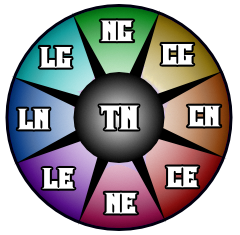
Reloading
Any weapon that fires a missile needs to be reloaded before it can be fired again. If the weapon has an aspect like Rld 1 that is the number of rounds it takes to reload the weapon. A crossbow with Rld 5 needs five rounds to be reloaded. The character can do nothing except reload the weapon during this time.
Although bows need to be reloaded, they have no Rld number. This means you can quickly reload it every time you shoot.
Slip Thru
Normally, you cannot move through a step occupied by another character or creature. However, if you are agile enough, you may be able to sneak past them with a Slip Thru. This is you ducking under, sliding past, or possibly even vaulting over whoever is in the way.
The check uses your Dexterity. Slipping past an ally is an Easy check. Slipping past an enemy is a Hard check. Trying to get past someone who is simply in your way is a normal check.
| Dexterity | |
| 1: | You make it thru! |
| ½: | Lose the rest of your movement. |
| F: | Stunned. |
| C: | Knocked Flat! |
A half success means you can't get past them and lose the remainder of your movement. A failure means you run into them and are stunned as if hit in combat, you lose the rest of your action. A crash knocks you flat on your back and now you need to spend an action standing back up again.
Back Attacks A slip thru is considered a part of your movement. You can make as many of them as you can and it won't effect the attack part of your action (unless you screw it up). One reason you might want to do a slip-thru is to make a back attack on an opponent. Succeed and you end up behind them. They defend with DC instead of AC.
Spell Casters
Arcane magic comes from reaching with ones mind into the spaces that exist between spaces, grabbing ahold of invisible currents of unfathomable power and spinning them into a pattern that will hopefully cause a spell to fire and not fry ones brain to a cinder. The spells your character knows how to cast come from instructions written in spell books, as well as countless hours spent reading and practicing them.
Spell Acquisition Brand new characters get to choose their starting spells. Established characters increase the number of spell levels they can memorize but do not get any new spells when they level up. New spells they need to find, buy, copy or steal while out adventuring.
Purchasing Spells On the black market (where most magic is sold) the cost of a spell is its Spell Level x $1,000 x 1d6. So a 3rd level spell starts at $3,000 and if the 1d6 rolls a 5 (3,000 x 5 = 15,000) the spell costs $15,000 from this particular vendor.
Spell Cost = Spell Level x $1000 x 1d6
Because spells are so expensive, spell-casters are often hesitant to share their spells. They paid heavily to acquire them (in theory at least) you should do likewise.
Copying Spells While the pages of a spell are not necessarily magical, it is quite a task to copy them. Penning a copy requires at least 1 hour per spell level. After that, a check needs to be made to see if the spell was copied correctly. Use the character's Dexterity + Class Level minus double the Spell's Level.
Copy Check = Dexterity + Class Level - (Spell Level x 2)
So a 4th level Wizard with a Dexterity 12 trying to copy a 3rd level spell would check a score of (12 + 4 - 6) a 10 to copy it. A half success gives you a copy that works but with a Hit -2. Fail and you need to start over again. Crash and you tipped over the ink well, destroying both the spell you were making as well as the one you were copying.
Brand New Spells Once you get your hands on a new spell, it takes 4 hours of study per spell level before you can attempt to cast it, so that new 3rd level Fireball spell you just copied will still require at least 12 hours of study and practice before you can cast it.
Once you have learned the spell you can intentionally forget it and then relearn it and the time it takes is just 1 hour per spell level.
Scrolls & Spells Scrolls are not spells. They are one-shot magic items. Reading one aloud releases the magic locked up in the paper and destroys the scroll. The writing on the scroll is often gibberish. Try as you might, you cannot learn a spell from a scroll.
Focusing Tools Focusing Tools are often wands, staffs or rods that carry a quality bonus. If you have a Magic Wand +3 which is not tied to any spell-like power? That's a focusing tool. You get a +3 for any spell cast with its assistance. Only one focusing tool may be used at a time. They cannot be used with magic items or to help copy spells.
The +3 on something like a Wand of Fireballs +3 is a form of focus but it only works with the spell locked up in the wand. If a magic item has more than one spell-like power then its focus works with all of them.
Spell-Casting Skills There are a number of skills named after different types of spells, such as Illusion Spells or Conjuration Spells. These can be used to provide a bonus to casting just that type of spell. It is good to know that these only help with the casting of a spell. If your class does not let you cast illusions then the Illusion Spells skill will not let you cast them either. Divine-casters and power-users may not use spell-casting skills.
Vocals & Gestures Unless something says otherwise, spell casters need to utter some magic words and wave their hands around in order to cast a spell. If you cannot do this then the spell cannot be cast. Usually. You may cast a spell in a hushed tone and with sublime hand gestures in order to keep from drawing attention to yourself but this will harden the cast.
Spell Casting Unlike the original game, you do not forget a spell after casting it. You can cast it over and over again until you fail or crash — then you forget it — X the spell out of your attacks list. The only way to get it back is to spend 1 hour per spell level relearning it from your spell book. If you no longer have your spellbook or that individual spell then there is no way to recover it.
When a spell cast crashes, not only do you forget the spell but the unhinged arcane magic surrounding you goes haywire. The DM will roll once on the Spell Casting Crash table in the DMG to figure out what happens next. This can range from growing small horns in strange places to your head explodes.
Do not risk crashing a spell if you can help it!
Surprise Attacks
A surprise attack is an ambush. No initiative is rolled. Instead, everyone who is hiding makes a Wisdom check to see how well they are hidden. Those about to be ambushed also make Wisdom checks to see if they notice it. When the worst strength of the ambushers beats the best strength of the ambushees a surprise attack happens.
Surprise Attack = Worst Ambusher > Best Ambushee
The party launching the surprise attack gets one round where they can attack and the surprised party can do nothing but take damage. Stupefied, they defend with DC. If there is another round after this one it continues as normal combat.
Swimming
If you have the Swim form of movement then swimming is not a problem. Otherwise, once you hit the water you need to make a Muscle check. Rough water caused by waves or rapids will harden the check. Simply being in the water doubles the weight of whatever you are carrying for purposes of encumberment.
| Muscle | |
| ½: | You swim with a speed equal to your Muscle strength / 4. |
| F: | You sink to the bottom. |
| C: | Startled, you inhale water and drown! |
Succeed and your swim speed is your muscle strength divided by four. A strength of 12 gives you Swim 3. A strength of 20 gives you Swim 5.
Breath Holding At the end of each round spent holding your breath make either a Constitution or Spirit check. Wear damage should be multiplied by your body size Dmg.
| Constitution or Spirit | |
| 1: | Everything is fine. |
| ½: | Take 1 point of wear damage. |
| F: | Take 2 points of wear damage. |
| C: | Inhale water and drown! |
Drowned Characters A drowned character is essentially dead but they can be brought back to life with artificial resuscitation.
This requires a Hard Intellect check by whoever is attempting the resuscitation. Characters with the Wilderness Survival skill may use it for a bonus. For every success that comes from it the drowned character gets to make one Constitution Save. Success means they cough out some water and start breathing again.
Fighting in Water If your character is not a natural swimmer being in the water will harden any attack you make and cause you to defend with DC. Any character stunned in combat will suddenly exhale, inhale and drown.
Vision
There are three levels of light in this game: Daylight, Normal, and Dark. Daylight is bright and cannot be replicated by artificial means. Normal light is the kind of light you get from torches, lanterns and candles. Dark is a complete absence of light. How different levels of light effect your character depends on their kind of vision.
Normal Normal vision works well in daylight and normal light but takes a -6 in complete darkness. Any activity that requires light (like reading) cannot be done in the dark. Anyone who doesn't have ultravision will have normal vision by default.
Darkvision Darkvision is normal vision adapted to low light conditions. Those who have it take a -2 when seeing by daylight or immersed in perfect darkness. Darkvision cannot actually see in the dark. The character is simply more familiar with it.
Ultravision Ultravision sees the minute traces of radiation that everything gives off. It is good enough to read with but colors often come across as garish and weirdly fluorescent, like seeing the world through a blacklight poster. Ultravision is the reverse of normal vision. It works best in complete darkness or dim light but takes a -6 in daylight. Sunlight is especially painful to those with ultravision and will eventually blind them if exposed to it for too long.
Infravision Infravision sees heat patterns. It cannot see colors or be used to read, but infravision can see equally in all levels of light. Infravision may be blinded by large sources of heat. It also tends to miss anything whose body heat is the same as the ambient temperature of the room. For this reason, infravision cannot see undead creatures. It takes one combat round to switch between infravision and a different kind of vision.
While all of this may seem like a lot, it is pretty easy to keep track of using the table below.
| Vision | Daylight | Normal | Dark |
| Normal | +0 | +0 | -6 |
| Darkvision | -2 | +0 | -2 |
| Ultravision | -6 | +0 | +0 |
| Infravision | +0 | +0 | +0 |
Options
Options is for those rules which haven't exactly made it into the game. These are ideas which may be experimental or seem promising yet possess some kind of complication which is holding them back. You may use optional rules in your game just be sure to talk it over with the rest of your group. Should any of optional rules become a permanent fixture of your campaign, write it down somewhere as a House Rule. Keep this list handy so you don't burn up too much brain power trying to remember if a rule is in use or not.
Dodge
When an attack comes your way — after your opponent has rolled to hit but before you roll for armor & shield — you may attempt to dodge the attack as your action for the round. This uses the same action as Diving for Cover except it is always a Dexterity check. Success determines how much damage you take (and armor & shield reduces it further). You may not dodge an attack when defending with DC.
| Dexterity | |
| 4: | No Damage. |
| 3: | Tenth Damage. |
| 2: | Quarter Damage. |
| 1: | Half Damage. |
| ½: | Full Damage. |
| F: | Double Damage. |
| C: | Triple Damage. |
Because rounds are just three seconds long. This dodge will protect you against any attack to come your way for the rest of the round. Unless you failed the dodge. Failure only compounds the damage done by the initial attack that you dodged.
If you have already made your action for the round you can still dodge an attack, but you lose your action in the coming round to do so.
If you can make multiple attacks, the dodge uses up one of your attacks instead of the entire action. If the attack is a hard one your dodge should be likewise.
Why is it optional? Because dodging is one more thing to think about and it requires characters acting out of order which can get confusing if you have too many people doing it too often.
Parry
Parrying blows with your weapon is considered a part of what makes your AC work but for the most part it is over-looked by the system. Parrying is something your character does automatically without you having to mention it.
Parrying in place of an attack is something you need to declare in combat. It is something you intentionally do to either avoid taking damage or stop someone within reach of your attack from taking damage.
Essentially, if you haven't gone yet in this round, you can declare that you are parrying blows when an attack comes your way. Check your hit score and roll for damage (nothing opposes this check). What you get is a number of Parry Points that can be spent to reduce the damage of attacks like an extra layer of armor. Parry point are lost as they are used and do not carry over between rounds. Use them before you lose them!
You can parry different kinds of attacks (ex: parrying a Ranged attack with a Melee attack) but this changes the number of parry points it takes to thwart 1 point of damage using the table below.
| Parrying | Melee | Ranged | Thrown | Unarmed |
| Melee | 1 | 3 | 2 | 1 |
| Ranged | 2 | 4 | 3 | 2 |
| Thrown | 2 | 4 | 3 | 2 |
| Unarmed | X | X | X | 1 |
The rows are what you are using and the columns are what you are parrying. So a Melee attack requires 1 parry point to stop a point of melee attack, 3 points to stop a point of ranged attack, 2 points to stop a point of thrown attack, and 1 point to stop a point of unarmed attack. Unless something says otherwise, unarmed attacks can only parry other unarmed attacks.
Why is it optional? In a word: bookkeeping. To make it work you need to keep track of a mess of numbers. It also helps to know that parry table by heart so the game doesn't slow down as people try to remember how it all works.
Swing Initiative
With Swing Initiative you figure out initiative in the usual fashion but instead of everyone on a side going all at once, just one character or creature from the winning side goes. After that one character or creature from the other side goes. Back and forth combat swings between the two sides until everyone has gone. At that point the current round ends and a new round begins.
A good reason to use it is because swing initiative does a better job of capturing the general chaos of combat. It no longer feels as if one side is standing still, waiting to take damage, while everyone else moves around them. It also leads to strategic thinking as you try to decide who should go first and who should save their action for later.
A good reason to avoid it is because swing initiative is harder to keep track of as the game bounces around the table, especially with large numbers of players or people running multiple characters. Swing initiative is also slower than normal combat. If you have ever picked a kickball team in gym class you know just how long it can take to pick between two or more characters.
Cardinal Rules
Once you understand them, all of these rules can be changed to your liking. There are only three rules that cannot be modified or over-ruled. These we call the Cardinal Rules.
What Seems Real Is Real Reality is a big and beautiful thing. To capture it in all of its glorious detail with every single oddity, conundrum and contradiction perfectly set in place would require the creation of a gaming system as vast as the universe itself. As it is we have a small fast-moving game that runs on pencils, paper, dice and imagination.
When you come across an absence in the rules, an oversight or something that just doesn't make any sense? Think about it. Try to see the adventure as if it were really happening and listen to your imagination.
What seems real is real.
The DM is Always Right Even when dead wrong. Deciding what is real about magic and elementals is no small task, so no matter how off-center, irrational or glaringly bad a DM's decision may be the Dragonhead Master is always right. In every debate the DM has final say.
This is not because we believe your DM to be infallible (far from it!) but because games only suffer when people waste time arguing about what one thing or another actually means. The DM always has a good reason for doing whatever the DM has done and is under no obligation to explain it. Just take it on faith that everything will make sense in time. Of course, any DM who abuses this privilege had better be prepared to find a new gaming group sometime soon.
The DM is always right.
Always Play to Win There are no winners or losers in RPGs. This sage old advice is utter nonsense. These games can be won and they can be lost, but not in the way that most people think.
You will know you are losing when boredom sets in. When conversations stray from the adventure at hand. When people start playing with their phones rather than their characters.
You are winning when the air crackles with laughter and excitement. When eyes widen and people wish the adventure would never end.
That is winning!
And winning is the responsibility of everyone at the table.
We all win or we all lose.
Always play to win!
- Adventure
- Armor Sacrifice
- Area Attacks
- Aspects
- Body Size
- Burst Attacks
- Climbing
- Cover
- Damage Type
- Disarm
- Divine Casters
- Falling
- Fire
- Food & Water
- Grappling
- Healing
- Hirelings
- Jumping
- Kicks
- Magic Items
- Morale & Fear
- Picking Pockets
- Poison
- Power Users
- Push
- Role Playing
- Reaction Rolls
- Reloading
- Slip Thru
- Spell Casters
- Surprise Attacks
- Swimming
- Vision